


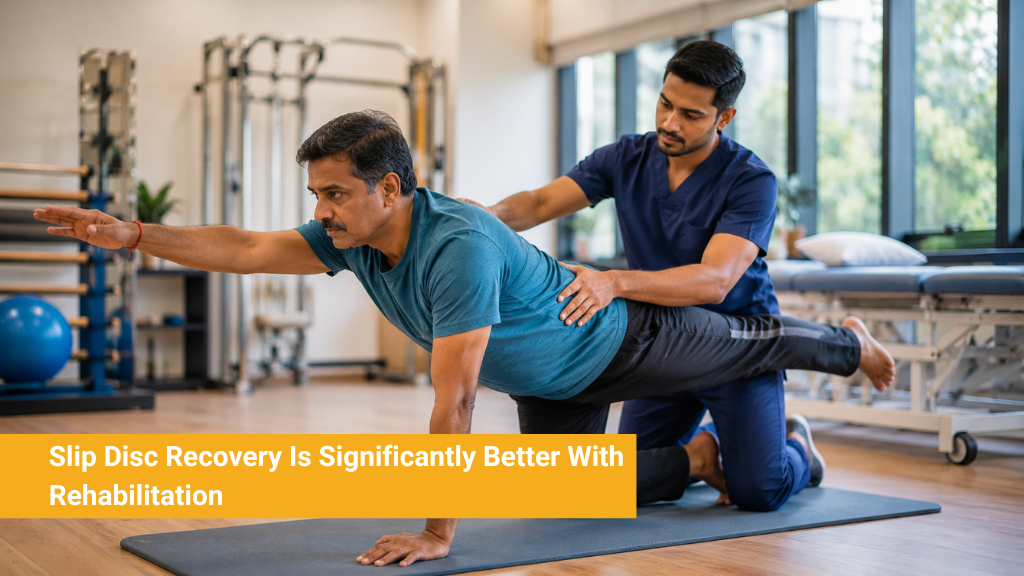
Slip disc or lumbar disc herniation is one of the most common causes of back and leg pain in India and one of the most commonly mismanaged. The default response, across households and even some clinical settings, is rest: lie still, avoid movement, wait for the pain to pass. For a small proportion of patients, the pain does eventually subside. For a much larger proportion, it often returns, becoming worse and is now accompanied by a spine whose supporting muscles have weakened from disuse.
Rehabilitation changes this trajectory. The evidence for physiotherapy in slip disc recovery is among the strongest in orthopaedic medicine, showing better pain outcomes, faster return to function, lower recurrence rates and reduced surgical rates compared to rest alone. The question for most patients is not whether rehabilitation works. It is why it is so rarely started early enough or completed thoroughly enough, for those benefits to be fully realised.
What a Slip Disc Is and What It Is Not
The spine is built around intervertebral discs (shock-absorbing structures that sit between each vertebra), with a tough outer ring and a gel-like inner nucleus. When the outer ring tears or weakens, the inner nucleus can bulge outward (toward the spinal canal and the nerve roots that exit at each level). This is a disc herniation. The term ‘slip’ is colloquial and slightly misleading as the disc does not move out of place wholesale. It deforms and in doing so presses on adjacent nerve tissue.
The pain this causes can be local (in the back or neck) or referred along the nerve path, producing the characteristic shooting, burning, or tingling that runs into the arm or leg. The specific symptoms depend on which disc has herniated and which nerve root is compressed. In the lumbar spine, this commonly produces sciatica. In the cervical spine, it produces arm and hand symptoms.
Why Rehabilitation Produces Better Outcomes Than Rest
Rest is not a neutral choice after a slipped disc. On the contrary it can remove the mechanisms through which disc recovery and spinal stabilisation occur. Rehabilitation introduces them. The difference in outcomes across each dimension of recovery is consistent:
Factor | With Rehabilitation | With Rest Alone |
Pain management | Active pain reduction through targeted exercise, manual therapy and postural correction | Temporary relief that frequently returns (often worse) once activity resumes |
Muscle support | Core and paraspinal strengthening that stabilises the disc and reduces recurrence risk | Rapid muscle atrophy that removes the spine’s natural support and increases instability |
Disc recovery | Controlled movement promotes fluid exchange in the disc, supporting hydration & healing | Prolonged immobility slows disc nutrition, which occurs through movement, not blood supply |
Nerve symptoms | Neural mobilisation techniques reduce nerve root irritation and restore conduction | No mechanism to address nerve sensitisation – pain and tingling persist or worsen |
Return to function | Structured progression toward sitting, standing, walking, and work within a defined timeline | Unpredictable and frequently incomplete return to pre-injury activity levels |
Recurrence risk | Substantially reduced by addressing the mechanical and movement factors that caused the disc to fail | Unchanged or increased – the underlying vulnerability is never corrected |
Living With Slip Disc Pain? Rehabilitation Changes the Outcome.
At Sukino, slip disc rehabilitation is built around the individual considering the specific disc level, the pattern of nerve involvement, the patient's work and activity demands, and the movement habits that contributed to the injury. Our physiotherapists do not prescribe a generic set of exercises. They address the cause.
If you or your loved one is recovering from a slipped disc, our structured rehabilitation can help restore mobility and improve symptoms. Contact Sukino's rehabilitation team to learn more.
Click HereWhat Slip Disc Rehabilitation Actually Involves
A physiotherapy programme for disc herniation is not a uniform set of exercises prescribed at the first appointment and unchanged for six weeks. It is an adaptive, clinical process that changes as the patient’s pain and function change.
What a structured slip disc rehabilitation programme addresses:
- Pain and inflammation – manual therapy, heat, traction, and targeted exercises to reduce nerve root irritation
- Core stability – deep spinal stabilisers that protect the disc are almost always weakened after a disc event; rebuilding them is the foundation of long-term recovery
- Postural correction – the forward-lean, protective postures patients adopt during acute pain become chronic problems if not corrected
- Neural mobilisation – specific techniques that restore nerve glide and reduce the sensitisation that causes radiating leg or arm pain
- Movement re-education – relearning how to bend, lift, sit and carry in ways that do not repeatedly load the vulnerable disc
- Ergonomic & activity guidance – workstation, vehicle and home modifications that protect the spine during recovery and beyond
- Graduated return to activity – structured progression back to work, exercise, and daily function based on tolerance, not guesswork
Warning Signs: When to Seek Urgent Review
Though a large majority of slipped disc symptoms can be managed conservatively through rehabilitation, for a few you may need to visit an expert immediately. These symptoms should never be attributed to normal disc pain and managed with rest.
When to seek urgent medical review rather than continuing rehabilitation:
- Loss of bladder or bowel control
- Progressive weakness in the legs that is worsening rather than improving across days
- Numbness or tingling in the groin or inner thighs (saddle anaesthesia)
- Severe and unrelenting pain that does not respond to any position or medication
- Neurological symptoms appearing or significantly worsening despite rehabilitation
These symptoms suggest cauda equina compression or significant cord involvement that requires surgical rather than rehabilitative management.
FAQs
No the majority do not. Research consistently shows that the majority of people with a herniated disc recover adequately without surgery, provided they receive appropriate conservative management. Surgery is indicated when neurological symptoms are progressive and not responding to rehabilitation, when there is significant functional loss such as foot drop, or in the rare case of cauda equina syndrome. For most patients, a well-designed rehabilitation programme is both the first and the most effective treatment.
Short-term rest (one to two days) is reasonable during the acute phase of severe pain. Beyond that bed rest is associated with worse outcomes than active management. Prolonged rest allows core muscles to atrophy, removes the movement that nourishes the disc and allows pain sensitisation to entrench. Current clinical guidelines recommend remaining as active as pain permits and beginning structured rehabilitation as early as tolerated.
A bulging disc means the outer wall of the disc is intact but the disc is protruding beyond its normal boundary pressing on adjacent structures. A herniated or slipped disc means the outer wall has torn and the inner nucleus has pushed through potentially contacting nerve roots directly. Both can cause significant pain and neurological symptoms. Both respond to rehabilitation, though the severity and urgency of intervention differ.
Most patients with a lumbar disc herniation experience symptom improvement within 6 to 12 weeks of tailored rehabilitation. Full functional recovery including return to physically demanding work or sport may take 3-6 months. The key variable is consistency. Patients who complete their programme reliably including home exercises between sessions, recover faster and more completely than those who attend sporadically.
Disc herniations can recur, particularly if the underlying factors like poor core stability, repetitive loading, and ergonomic habits are not addressed. This is precisely the reason that good slip disc rehabilitation does not stop at pain relief. It identifies and corrects the mechanical vulnerabilities that allowed the disc to fail in the first place: weak stabilisers, faulty movement patterns, postural habits, and work or lifestyle factors that need modification. A patient who completes rehabilitation properly has a significantly lower recurrence risk than one who stops as soon as the pain subsides.


