


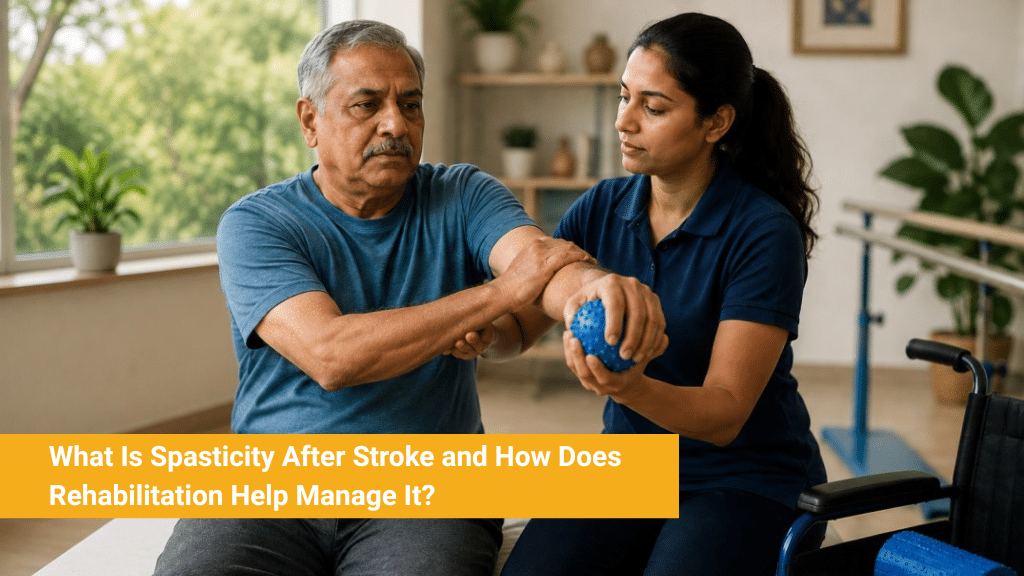
Spasticity is one of the most functionally significant and most frequently undertreated consequences of stroke. It develops in a substantial proportion of stroke survivors in the weeks following injury, progressively tightening muscle groups that the damaged brain can no longer regulate normally. Left unmanaged, it leads to contracture, chronic pain, functional deterioration and a level of caregiver difficulty that families rarely anticipate at the point of discharge.
Understanding what spasticity is, how it differs from simple muscle stiffness and what a structured rehabilitation programme can do to manage it is essential for any family supporting a stroke survivor beyond the acute hospital phase.
What Spasticity After Stroke Actually Is
Spasticity is a motor disorder characterised by velocity-dependent muscle stiffness – meaning the resistance in the affected muscle increases the faster it is moved. It arises because the stroke has damaged the upper motor neuron pathways that normally regulate and inhibit muscle tone. Without that inhibitory control, the muscles below the injury site become hyperactive, contracting excessively and resisting passive movement.
This is not the same as the general stiffness that comes from immobility or deconditioning. Spasticity originates in the nervous system – in the disrupted signals between the injured brain and the muscles it can no longer properly control. Which is why managing it requires neurological rehabilitation, not simply increased physical activity.
How Post-Stroke Spasticity Presents
The pattern of spasticity varies with the site of the stroke and which motor pathways were damaged. It most commonly affects the arm and leg on the affected side & tends to follow predictable patterns of muscle group involvement.
How post-stroke spasticity typically presents:
- Arm bent at the elbow, curling of wrist inwards, fingers clenched – the classic flexor pattern.
- Leg stiff and extended, foot pointing downward (foot drop) – making walking effortful & unsafe.
- Increased muscle tone that resists passive movement – the limb feels rigid to the touch.
- Involuntary muscle spasms, particularly at night or with sudden movement
- Pain or discomfort in the affected limb, often described as tightness or cramping
- Difficulty with personal care – bathing, dressing, nail care – due to clenched hands or stiff limbs
Why Unmanaged Spasticity After Stroke Becomes a Serious Problem
Spasticity is not a static complication. Without active management, it tends to worsen – and its consequences compound over time. Families who assume that tightness in the affected arm is simply a feature of stroke to be tolerated often discover, months later, that what was manageable has become a significant clinical problem.
What happens when spasticity after a stroke is left unmanaged:
- Contractures – permanent shortening of muscle and tendon that locks a joint into a fixed position
- Pressure sores – skin breakdown from abnormal posture and inability to reposition
- Chronic pain – undertreated spasticity is a significant source of ongoing discomfort
- Falls – spastic gait patterns greatly increase fall risk and re-injury
- Functional deterioration – tasks the patient could manage in early recovery become impossible as tone increases
- Caregiver burden – rigid limbs make washing, dressing, and repositioning considerably harder and more painful
Managing Spasticity After Stroke Requires Early, Specialist Input
Spasticity left unaddressed does not plateau - it progresses. At Sukino's centres in Bangalore, Kochi, Coimbatore, Calicut and Hyderabad, spasticity management is embedded into every stroke rehabilitation programme from the outset. Our neurologists, physiotherapists, and occupational therapists work together to reduce tone, prevent contracture, and protect whatever function remains - before it is lost to a condition that was entirely manageable.
If your loved one is managing spasticity from a stroke, specialised neuro rehabilitation can make a significant difference in recovery. Contact Sukino's neuro rehabilitation team to learn more about personalised treatment plans.
Call us or visit sukino.comHow Rehabilitation Manages Spasticity After Stroke
Spasticity management is not a single intervention. It is a layered, coordinated approach that combines rehabilitation techniques with medical treatment where needed and the balance between these changes as the patient progresses. The most effective programmes address spasticity from the earliest days of rehabilitation, before contracture has time to set in:
Intervention | What It Does and When It Is Used |
Stretching and positioning | Daily passive stretching and correct positioning of affected limbs reduce tone, prevent contracture and maintain joint mobility |
Physiotherapy | Task specific neurological physiotherapy retrains movement patterns in your body and works to reduce abnormal tone through purposeful, repetitive activity |
Splinting and orthotics | Custom splints hold joints in a corrected position, preventing contracture and supporting functional posture between therapy sessions |
Occupational therapy | You may be guided to adapt techniques for dressing, feeding and personal care. |
Botulinum toxin (Botox) | Injected into specific muscles to reduce localised spasticity for three to four months; most effective when combined with intensive physiotherapy |
Oral medications | Baclofen, tizanidine, or diazepam may reduce generalised tone; benefits must be weighed against sedation and functional side effects |
Intrathecal baclofen | A pump delivering baclofen directly to the spinal fluid – reserved for severe, diffuse spasticity not responsive to other interventions |
FAQs
No but it does not mean that it is uncommon. Many stroke survivors develop clinically significant spasticity mostly within the first weeks to months following the stroke. Some patients experience mild tightness that responds well to stretching and physiotherapy. Others develop severe spasticity that significantly limits function and requires medical intervention alongside rehabilitation.
Spasticity may emerge over the following days to weeks as the nervous system responds to the injury. In some patients it peaks early and then reduces with treatment while in others it increases progressively (if not actively managed).
General muscle stiffness from immobility is common after any prolonged illness and improves with movement. Post-stroke spasticity is velocity-dependent (the resistance increases when the limb is moved quickly) and originates in the nervous system & not the muscle itself. The muscle is responding to abnormal signals from an injured brain. Treating it as simple stiffness, rather than a neurological problem, leads to incomplete management.
The goal of spasticity management is not necessarily elimination but control. It reduces tone sufficiently to maintain joint mobility, enable care, reduce pain and preserve whatever motor function exists. With early rehabilitation & medical intervention many patients achieve better outcomes.
Botulinum toxin injections are used when spasticity in specific muscles is so severe that it limits function or causes pain and you are not getting any relief from rehabilitation alone. Crucially, Botox does not replace physiotherapy – it creates a temporary reduction in tone that makes physiotherapy more effective.
Family has a huge role to play. They can help with the following
- Daily passive stretching of the affected limbs (it should be performed correctly and consistently) is one of the most important preventive measures against contracture.
- Correct positioning of the arm or leg during rest and sleep matters
- Awareness of triggers that worsen tone (pain, stress, urinary retention, cold) and addressing them can reduce spastic episodes
As a clinical priority embedded from the first days of rehabilitation, it is not a complication addressed once it has become severe. Sukino’s teams assess tone systematically, implement positioning and stretching protocols early and coordinate between physiotherapy, occupational therapy, and medical intervention – including botulinum toxin where indicated – to manage spasticity as part of the overall stroke recovery plan.


