


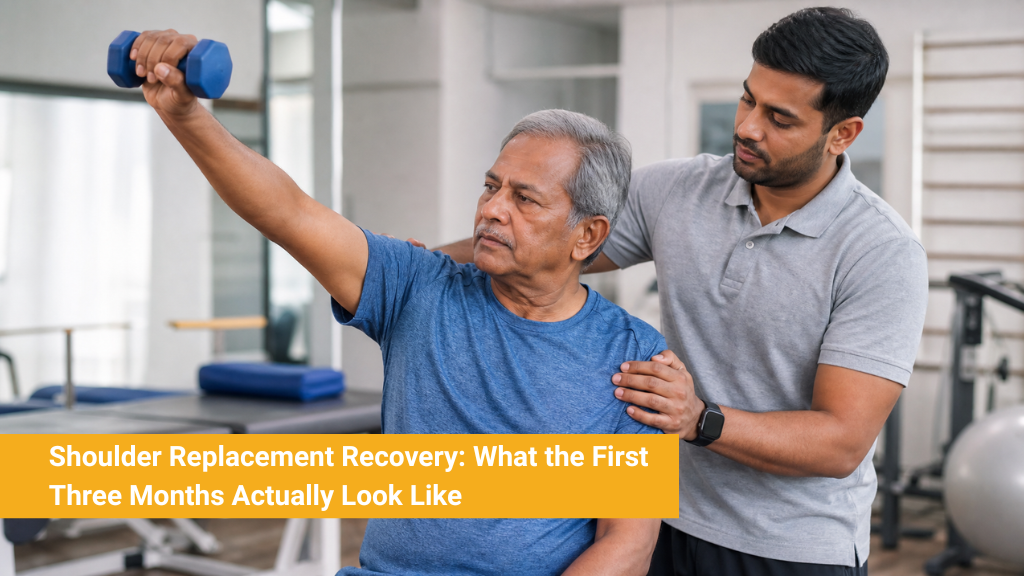
Shoulder replacement surgery addresses a joint that is unique in the human body. It offers a greater range of motion than any other, which makes it both remarkably functional when healthy and particularly demanding to rehabilitate when it has been surgically reconstructed. Most patients arrive at the procedure with a clear understanding of what the surgery involves but very few have an equally clear picture of what follows.
The first three months after shoulder replacement are the period that most directly determines long-term outcome. Decisions made during this window (when to move, how much, in which directions, when to load) are not matters of patient preference. They follow the biology of tissue healing and departing from the timeline in either direction carries specific consequences. This article sets out, phase by phase, what recovery from shoulder replacement actually involves.
Why Shoulder Replacement Recovery Is Longer Than Most Patients Expect
The shoulder is not a weight-bearing joint – but it is, in functional terms, one of the most demanding joints in the body to rehabilitate. It moves in more planes than any other joint, and almost every activity of daily life – dressing, eating, bathing, reaching – requires some degree of shoulder function. This means recovery cannot happen in the background while the patient rests. It requires active, progressive, clinically guided rehabilitation from the first week.
The shoulder also involves a rotator cuff – four muscles and their tendons that stabilise the joint and power its movement – that is frequently repaired or handled carefully during the surgical approach. Protecting this tissue while stimulating the motion that prevents stiffness is the central challenge of the first six weeks. Move too little and the shoulder stiffens into a range that never fully returns. Move too much, too soon, and the repair is compromised.
The Shoulder Replacement Recovery Timeline: Week by Week
Recovery from shoulder replacement follows a staged progression dictated by tissue healing rather than patient comfort. The following is a general guide including individual protocols vary by surgical approach, implant type and patient factors:
Phase | Recovery Focus |
Week 1-2 | Pain and swelling management; arm in sling at all times; pendulum exercises only & no active shoulder movement |
Week 3-4 | Gentle passive range of motion introduced by physiotherapist; elbow, wrist and hand exercises; sling use continues outside therapy |
Week 5-6 | Active assisted shoulder movements begin; scapular stabilisation exercises; gradual reduction in sling dependence under doctor’s guidance |
Week 7-8 | Active shoulder range of motion progresses; light daily tasks reintroduced with care; no lifting, pushing or pulling against resistance |
Week 9-12 | Strengthening programme begins once an adequate range of motion is established; functional tasks with increasing load; driving typically cleared around this point |
Recovering from Shoulder Replacement? Start Rehabilitation at Sukino.
At Sukino's centres, post-surgical orthopaedic rehabilitation is structured around exactly where you are in recovery - not a generic programme applied uniformly. Our physiotherapists work alongside your surgical team to progress range of motion, strength, and function at the rate your shoulder can safely support.
What to Avoid in the First Three Months After Shoulder Replacement
Most setbacks in shoulder replacement recovery are preventable. They usually arise from one of two sources: inadequate physiotherapy or exceeding the prescribed activity limits before the tissue has healed sufficiently to tolerate the load. The restrictions exist because the biology of tendon & capsular healing has a timeline that patient effort cannot accelerate.
What to avoid in the first three months after shoulder replacement:
- Lifting anything heavier than a cup of tea with the operated arm – until the surgeon specifically clears it
- Reaching behind the back – placing the shoulder in internal rotation under load before the soft tissue has healed
- Sleeping on the operated side – even brief episodes can displace the shoulder from its healing position
- Removing the sling without instruction – particularly in the first four weeks when the rotator cuff repair is most vulnerable
- Pressing up from a chair or bed with the operated arm – a habit that applies exactly the wrong force vector at the wrong time
- Driving before clearance – the steering correction reflex requires shoulder strength and rotation the early recovery does not yet support
- Skipping physiotherapy appointments – the exercises given are not optional extras; they are the recovery
Setting Up Home for a Safe and Manageable Recovery
Shoulder replacement is typically performed as an inpatient procedure with discharge within two to three days. The home environment into which the patient returns has a significant influence on how safely and comfortably the early recovery unfolds. These adjustments, made before the surgery date, prevent the most common domestic difficulties.
Practical home adjustments that make early recovery safer & less painful:
- Sleep in a recliner chair or propped upright with pillows for the first two to four weeks as lying flat strains the healing shoulder
- Place frequently used items at waist height on the unoperated side
- Arrange the bathroom so the patient can manage hygiene independently using the non operated arm
- Prepare loose-fitting front-opening clothing only – pullover tops, tight sleeves and bras are not manageable in the early weeks
- Keep medication, water, phone and essentials within arm’s reach on the unoperated side overnight
- Remove trip hazards – rugs, trailing cables & uneven thresholds – because a fall onto the operated arm in the first weeks carries serious risk
FAQs
Moderate to significant pain in the first two weeks is expected and does not indicate a problem with the surgery. The joint has been resurfaced, surrounding tissue has been cut and repaired and the body is responding with inflammation. Pain should be managed proactively with the medications prescribed. It typically reduces meaningfully between weeks two and four as swelling subsides, and continues to decline progressively through the first three months. Pain that is worsening rather than improving, or accompanied by fever or redness, warrants prompt surgical review.
Most protocols require sling use for four to six weeks with the specifics determined by the type of replacement and whether a rotator cuff repair was performed simultaneously. The sling protects the healing soft tissue. Removing it early even briefly and repeatedly, risks disturbing the repair before it has adequate tensile strength. Sling weaning is done gradually and under physiotherapy guidance, not at patient discretion.
Light daily tasks using the operated arm – feeding yourself, gentle grooming & writing – typically begin around weeks six to eight. Activities requiring any significant load, reaching overhead or behind-the-back movement are generally not cleared until three months at the earliest, and some not until six months. Full functional return including sport, heavy lifting, or physically demanding work is typically assessed at six months post-surgery. Rushing this progression is the most common reason outcomes fall short of expectations.
Physiotherapy is not optional after shoulder replacement – it is the mechanism by which the surgery achieves its purpose. The joint has been mechanically restored, but the surrounding muscles, tendons, and soft tissue still need to relearn how to move and load the shoulder correctly. Without guided rehabilitation, scar tissue forms in patterns that restrict movement, muscle atrophy continues, and the range of motion and strength that the surgery made possible is never fully realised. The shoulder may feel like it has improved. It will not reach its potential without the work.
Increasing rather than decreasing pain after the first two weeks, fever above 38°C, significant redness or warmth at the wound site, discharge from the incision, a sudden clunk or giving way in the joint, or loss of movement that was previously present all warrant urgent surgical review. Some degree of clicking and crepitus is normal as the new joint settles; sharp mechanical pain with movement is not. When in doubt, contact the surgical team.
With a staged, protocol-driven rehabilitation programme designed around the specific type of replacement and the individual’s pre-operative condition and recovery trajectory. Sukino’s physiotherapists liaise with the surgical team, progress range of motion and strengthening according to tissue healing timelines, and provide the patient and family with clear guidance on what is safe at each stage – including practical home management advice that prevents the most common causes of setback.


