


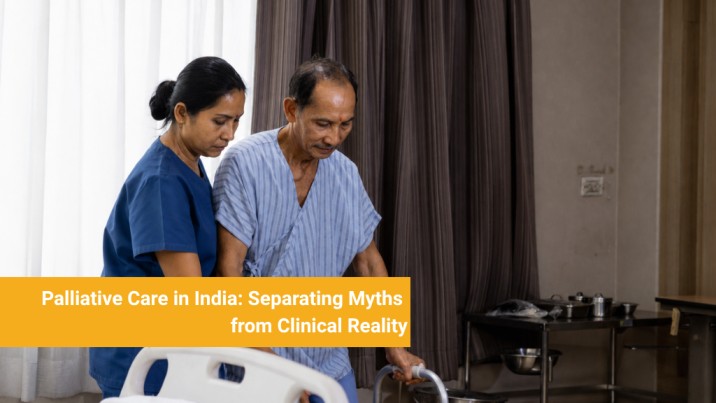
Palliative supportive care in India remains one of the most misunderstood disciplines in medicine. Families delay referrals. Patients interpret the conversation as an announcement of abandonment. None of that reflects what palliative rehabilitation in India actually is & the gap between perception and clinical reality has real consequences for patients who could benefit from it but receive it too late, or not at all.
India accounts for a big proportion of the global cancer burden, and the volume of patients with advanced chronic disease (including heart failure, end-stage renal disease, COPD, advanced neurological conditions) is large and growing. Against that volume, specialist palliative care services are still uncommon outside major urban centres. Many patients manage severe, treatable symptoms like pain, breathlessness, nausea, and psychological distress without adequate intervention (all this not because treatment does not exist but because the referral is made too late or not at all).
What Palliative Care in India Actually Means
Palliative care is the active, total management of patients with serious illness – managing pain, controlling symptoms, addressing psychological and social needs, and supporting families through a trajectory that may be uncertain in duration but not in direction. It is not withdrawal. It is not the end of treatment. It is not exclusive to cancer and it is not confined to the final days of life.
The World Health Organisation defines palliative care as an approach that improves quality of life for patients and their families facing life-threatening illness through early identification, assessment, and treatment of pain and other physical, psychosocial, and spiritual problems. That word “early” is clinically important. A landmark 2010 New England Journal of Medicine trial in patients with metastatic non-small cell lung cancer showed that early palliative care integration produced longer survival, better quality of life, and less aggressive care at the end of life compared to standard oncological care alone. The finding has since been replicated across disease settings and has changed how specialist centres approach the palliative care referral conversation.
Myths About Palliative Care That Delay Referral
Myth 1: Palliative Care Means Giving Up
Palliative care and disease treatment are not mutually exclusive. If you or your loved one is receiving chemotherapy for metastatic colorectal cancer you can receive palliative intervention for pain and nausea simultaneously. A patient with Class IV heart failure on medical therapy benefits from concurrent palliative assessment of breathlessness and fatigue. The decision to integrate palliative care nursing is not a signal that curative treatment has ended. Rather it is you taking action against your symptoms regardless of where you are in the treatment course.
Myth 2: Palliative Care Is Only for Cancer
Advanced heart failure, end-stage renal disease, advanced COPD, motor neurone disease and late-stage dementia carry symptom burdens equivalent to or exceeding those of many cancers. Breathlessness in refractory heart failure is among the most distressing symptoms in medicine. Palliative care for elderly is for all diseases. The only indication it has is serious illness with significant symptom burden and care needs that extend beyond what disease-specific management alone addresses.
Myth 3: Opioids Should Be Reserved for the Terminal Phase
Morphine, oxycodone, and hydromorphone are analgesics. The WHO analgesic ladder places strong opioids at step three for moderate to severe pain unresponsive to non-opioid analgesia. The appropriate trigger for opioid prescribing is pain severity and character. Noway it indicates proximity to death. Fear of opioid prescribing is one of the most clinically significant barriers to adequate pain management in India and its consequence is patients spending weeks or months in avoidable pain. Physical dependence in the context of analgesic use for cancer pain is not addiction. Conflating these two concepts delays treatment that is both safe and indicated.
Talk to the Sukino Continuum Care Team
If you or a family member is living with a serious illness and symptom control has been inadequate, a consultation about palliative care in Bangalore, Kochi or Coimbatore with Sukino can be arranged alongside existing treatment. Early referral consistently improves outcomes. Remember, it is not a last resort and it does not mean treatment has ended. Sukino
What Palliative Care Services in India Delivers Clinically
A specialist palliative care consultation addresses several domains that disease-specific management typically does not cover in adequate depth:
- Pain assessment and analgesic titration: Pain is first characterised by type, whether nociceptive, neuropathic, visceral, or a combination, and then treated with a structured, individualised analgesic plan built on established WHO ladder principles.
- Breathlessness management: Refractory breathlessness is treated with carefully dosed medications that reduce the sensation of air hunger alongside agents that address the anxiety it triggers. Non-pharmacological measures (fan therapy, positioning, and breathing exercises) also help a lot.
- Nausea and appetite: Different mechanisms of nausea are targeted with different agents, ensuring treatment is matched to cause rather than applied as a blanket measure. For patients experiencing cancer-related appetite loss specific medical therapies are available to improve intake and preserve body composition.
- Psychological distress: Depression and anxiety are independently undertreated in advanced illness. SSRIs, SNRIs and short-acting benzodiazepines form part of pharmacological management with psychological support and dignity therapy address existential concerns.
- Family support and advance care planning: Goals-of-care conversations (establishing what the patient values, fears and wants from treatment) produce care plans that reflect patient preferences rather than default escalation, reducing family distress and rates of unwanted aggressive intervention.
FAQs
Palliative care is specialist symptom management and psychosocial support integrated alongside disease-directed treatment at any stage of serious illness. Hospice care is a specific model of palliative care delivered when disease-directed treatment is no longer pursued typically in the final weeks to months of life. All hospice care is palliative; not all palliative care is hospice. A patient on active chemotherapy can and should receive palliative care simultaneously.
At diagnosis of a serious, life-limiting illness, not when treatment options are exhausted. Evidence consistently shows that early palliative care integration improves symptom control, quality of life and family outcomes. The clinical question is not whether the patient is dying; it is whether unmet symptoms and care needs exist. Most patients with advanced serious illness have them.
No palliative care runs alongside active treatment – it does not replace it. A referral indicates that symptom management, psychological support, and care planning warrant specialist involvement. The two most common responses after a first palliative care consultation are relief that symptoms are being systematically addressed, and regret that the referral did not happen sooner.
Yes. Palliative care is appropriate for advanced heart failure, end-stage renal disease, COPD, motor neurone disease, advanced Parkinson’s disease, and late-stage dementia. Symptom burden and not disease label determine eligibility. Breathlessness in refractory heart failure responds to the same low-dose opioid and anxiolytic interventions used in cancer palliative care.
Pain is characterised by severity, location, quality and mechanism using validated tools including the Numerical Rating Scale and Edmonton Symptom Assessment Scale. Management follows the WHO analgesic ladder principles with adjuvant analgesics added based on pain type. Opioid rotation addresses cases where side effects limit dose escalation of a first-line agent.
Sukino palliative care covers:
- Systematic symptom assessment across physical, psychological, and social domains
- Review and optimisation of the analgesic and symptom management regimen
- Goals-of-care discussion with patient and family
- Coordination with the primary treating team.
It can be arranged at any point in the illness trajectory and does not preclude continuation of disease-directed therapy. Families are included from the outset.


