


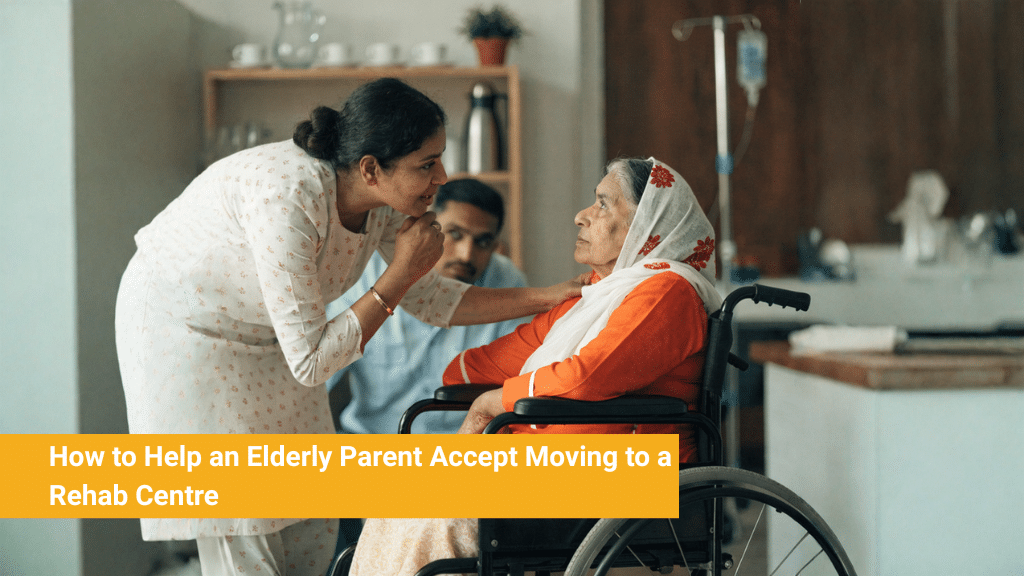
Few conversations in a family’s life are as charged as the one where an adult child suggests to an elderly parent that it might be time to move to a rehabilitation centre. The parent hears something different from what is being offered – not clinical support and structured recovery, but a loss of independence, a disruption to the life they have built, and sometimes an intimation of decline that they are not ready to face. The adult child, meanwhile, is trying to balance genuine concern for a parent’s safety with the fear of causing hurt, provoking conflict, or being seen as taking away something that belongs to someone they love. That gap – between what is being offered and what is being heard – is where most of these conversations break down, and understanding it is the first step toward having the conversation in a way that is more likely to go well.
Why These Conversations Go Wrong
The most common mistake families make is framing the conversation around practicality like the medical reasons, the list of services and the clinical evidence – when what the parent is actually responding to is something more fundamental: the fear of losing control over their own life. Once that fear is activated, rational arguments tend to deepen resistance rather than reduce it because the parent is not responding to the logic of the proposal but to the emotional experience of feeling that a decision is being made for them rather than with them. In most cases the conversation goes wrong not because the family chose the wrong facts but because they approached the wrong level of the problem.
How to Approach the Conversation Differently
The conversations that go well tend to share a common quality: the parent feels genuinely consulted rather than managed. This does not mean softening the recommendation to the point of meaninglessness – it means beginning from a place of curiosity rather than conclusion, asking the parent what their own concerns about recovery are, what they find most difficult about their current situation and what kind of support would feel acceptable to them. Framing a rehabilitation centre not as a place the parent is being sent to, but as a resource they are choosing to use for a defined period and a specific purpose – recovering strength, regaining independence, returning home – changes the emotional register of the conversation considerably. For families exploring the best rehabilitation centre in Bangalore, Kochi, Coimbatore, Calicut or Hyderabad involving the parent in evaluating facilities and asking their own questions can shift the dynamics from a decision being handed down to a decision being made together.
The table below offers a practical reference for reframing the language most likely to trigger resistance.
Instead of this. | Try this. |
“The doctor says you need to go.” | “What feels hardest about your recovery right now?” |
“We’ve decided this is the best option.” | “Would you be open to visiting one centre and seeing for yourself?” |
“You can’t manage at home anymore.” | “We want to make sure you get back to full strength – what would help most?” |
“It’s only temporary, don’t worry.” | “You stay for as long as it takes and come home when you’re ready.” |
Presenting a list of facility features | Asking what the parent’s own priorities for recovery are |
Not Sure Where to Begin? Let Sukino Help.
Sukino Rehabilitation offers inpatient rehabilitation, post-hospitalisation care, and continuum care services across Bangalore, Kochi, Coimbatore, Calicut and Hyderabad with multidisciplinary clinical teams experienced in working with elderly patients and their families. If your family is navigating this conversation and would find it helpful for a parent to visit one of our centres, meet the team, and ask their own questions in a low-pressure setting, we welcome that.
Speak with our care coordination team to arrange a visit.Timing and Setting Matter More Than Families Realise
The timing and physical setting of this conversation have a significant bearing on how it unfolds. A conversation initiated at the end of a tiring hospital day carries a very different emotional charge from one that happens at home, over tea, at a moment when the parent is comfortable and not in acute distress. Where possible, the conversation should happen before a crisis makes it urgent, because urgency removes the very thing that makes the conversation workable: the sense that the parent has time to think, to ask questions and to feel that their response genuinely matters. If other family members need to be present, it is worth agreeing in advance on who will lead the discussion, so that the parent does not experience the conversation as a coordinated effort designed to produce a predetermined outcome.
What to Do When the Parent Still Says No
When the parent declines – and many do, at least initially – pressing harder rarely gives the result families are hoping for. A more productive response is to acknowledge the refusal without abandoning the subject: to say, clearly and without pressure that the offer remains open & that the family’s concern is not going away. In the meantime, addressing the specific concerns that underlie the refusal – uncertainty about what post-hospitalisation care in Bangalore actually involves, concern about being away from home, not knowing what the daily environment looks and feels like – often shifts the conversation more effectively than any argument. Many families find that arranging a visit to Sukino Assisted Living Center in Bangalore, so that the parent can see the environment and meet the clinical team on their own terms, removes the fear of the unknown that is frequently the largest single barrier to acceptance.
Conclusion
The conversation about moving to a rehabilitation centre is rarely easy, but it is almost always possible to have it in a way that feels less like a confrontation and more like a decision made together – provided the family approaches it at the right level, at the right time, and with the parent’s sense of agency genuinely at the centre of the process. For families in Bangalore navigating this conversation, Sukino Rehabilitation’s care coordination team is available to help – whether that means answering clinical questions, providing information about what post-hospitalisation care and continuum care in Bangalore actually look like in practice, or simply welcoming a family and their parent for a visit at a time that suits them.
FAQs
Refusal is most commonly rooted in fear – fear of losing independence, fear of an unfamiliar environment, and sometimes an unwillingness to acknowledge the extent of their own decline. Understanding what specifically drives the reluctance, rather than countering it with clinical arguments, is usually the more productive starting point for the conversation.
Beginning from a position of genuine curiosity rather than a predetermined conclusion – asking about the parents’ own concerns, what is most difficult about their current situation, and what kind of support would feel acceptable to them – is more likely to open the conversation than a presentation of medical reasons and facility features.
Family disagreements about elder care decisions can themselves become a significant source of conflict, and it is worth aligning on the key messages and approach before the conversation with the parent takes place, to avoid the parent feeling caught between competing family positions or experiencing the discussion as an overwhelming coordinated front.
Not exactly. Assisted living center Bangalore give longer term accommodation for elderly individuals (needing help with daily living) while rehabilitation centres help in clinical recovery after an illness or surgery.
Continuum care in Bangalore refers to a model of care that supports a patient across different levels of need ranging from inpatient rehabilitation to home based recovery rather than treating each stage as a separate clinical event. For families navigating post-hospitalisation care in Bangalore a continuum care provider like Sukino Rehabilitation can support the patient through every phase without requiring disruptive transitions between unconnected care settings.
Sukino Rehabilitation offers inpatient rehabilitation, post-hospitalisation care, and elder care services in Bangalore, with multidisciplinary clinical teams experienced in working with elderly patients and their families. A visit to one of Sukino’s centres – allowing the parent to see the environment and ask their own questions – is often the most effective way to move the conversation forward.


