


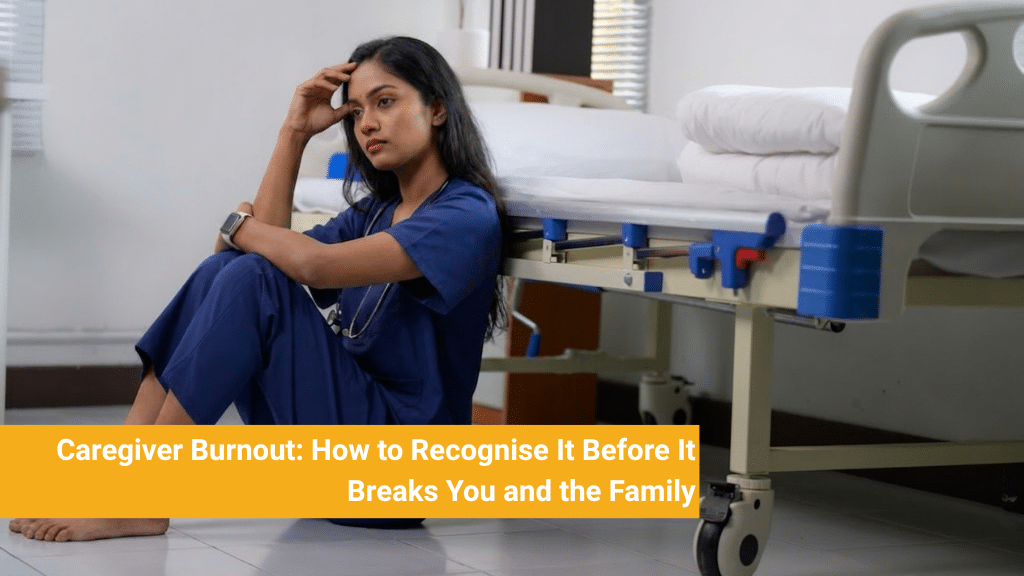
Caring for a family member who is recovering from a serious illness, surgery, or a long-term condition is one of the most demanding roles a person can take on – demanding not only in terms of time and physical effort, but in the sustained emotional and psychological weight that accumulates, often invisibly, over weeks and months of continuous caregiving. Caregiver burnout is the term used to describe the state of physical, emotional, and mental exhaustion that results from this cumulative toll, and it is far more prevalent than most families recognise until it has already begun to affect both the caregiver’s own health and the quality of care they are able to provide.
What Caregiver Burnout Actually Looks Like
This burnout is a gradual erosion and its early signs are easy to dismiss as ordinary strain. The exhaustion that accompanies it differs from the tiredness that follows a hard week. It does not go away regardless of how much sleep the caregiver gets, the kind that makes the day feel heavy before it has properly started. What follows is a slow emotional withdrawal (from the person being cared for, from friends outside the home and eventually from the parts of life that gave the caregiver a sense of themselves beyond this role). Resentment surfaces, quietly and then less quietly and with it comes guilt, because the caregiver knows that resentment and love are not supposed to coexist in this way. Difficulty concentrating, a shortened fuse, neglected personal health and a shrinking sense of identity are all part of the same picture and their combination deserves a serious response.
The table below maps the domains across which burnout shows itself, as a reference point for families trying to assess whether what they are experiencing is ordinary caregiving strain or something (caregiver stress symptoms) that warrants a more deliberate response.
Domain | Signs to Watch For |
Physical | Persistent exhaustion that does not improve with rest; frequent illness; disrupted sleep |
Emotional | Detachment from the person being cared for; feelings of resentment or guilt; emotional numbness |
Behavioural | Withdrawal from social relationships; neglecting personal health appointments; reduced patience |
Cognitive | Difficulty concentrating; forgetfulness; trouble making decisions |
Identity | Loss of sense of self outside the caregiving role; feeling trapped or without purpose beyond care |
Why Family Caregivers Carry More Than They Should
There is an important distinction between professional caregiving and family caregiving that the healthcare system rarely makes explicit: professional caregivers work defined hours, within institutional structures, with colleagues and the clear separation of a commute home at the end of a shift. Family members caring for a parent, spouse or sibling have none of these boundaries. The care does not end at a scheduled time, there is no handover, and the emotional stakes – grief, role reversal, fear – are absent from professional caregiving in the same way. What makes this harder still is that family caregivers are rarely asked how they are managing; clinical attention is, understandably, directed at the patient. Professional caregiver services offered through managed home healthcare can change this in a practical way, providing trained caregivers who take on the physical demands of care at defined intervals and give the family member genuine space to recover.
Is Your Family Carrying Too Much of the Care Burden?
Sukino Rehabilitation offers professional caregiver services at home and managed home healthcare, providing trained clinical support within the home environment so that family members can step back from intensive caregiving at defined intervals without compromising the standard of care their loved one receives. Our continuum of care spans inpatient rehabilitation through to home-based support, designed to distribute the caregiving burden sustainably across the recovery journey.
If you are looking for caregiver Service at Home in Bangalore speak with our care coordination team today.How Burnout Affects the Person Being Cared For
The connection between a caregiver’s wellbeing and a patient’s outcomes is well-established in the research literature. A caregiver who is exhausted and emotionally depleted makes more errors with medications, misses changes in the patient’s condition, and is less able to maintain the warmth and patience that personal care requires. The patient’s recovery is directly dependent on the caregiver’s capacity to sustain the role – which means supporting the caregiver is not separate from the clinical plan. It is part of it.
What Families Can Actually Do
Naming burnout is the first and often the hardest step, because it requires acknowledging that temporary strain has become something more serious. Once named, it calls for a structural response – sharing care responsibilities more equitably across the family, engaging professional caregiver support at home, and in some cases accessing respite care through an inpatient rehabilitation facility so that the primary caregiver gets a genuine recovery period. Sukino Rehabilitation’s continuum of care spanning inpatient rehabilitation, managed home healthcare and professional caregiver services, is built around the understanding that the caregiving burden (if not distributed and supported) eventually collapses under its own weight. Seeking psychological support for the emotional dimensions of the role is equally important and should be understood for what it actually is. It is not a sign of failure but evidence that the caregiver has been carrying more than one person can.
If you are looking for respite care for caregivers Bangalore contact our team today.
Conclusion
Caregiver burnout is not an inevitability of the role. It is a predictable consequence of carrying too much, for too long, without adequate support and it can be prevented or meaningfully reduced when families are willing to name it and respond before the situation reaches a breaking point. For families supporting a loved one through rehabilitation or long-term recovery Sukino Rehabilitation’s professional caregiver services and managed home healthcare programmes offer a practical and clinically grounded way to share the burden, protect the caregiver’s wellbeing and sustain the quality of care the patient deserves.
FAQs
Caregiver burnout is a state of chronic exhaustion. You can feel it physically, emotionally and psychologically. It accumulates through sustained high-demand caregiving without adequate rest or support and it differs from ordinary tiredness in that it does not resolve with sleep or short breaks but deepens progressively, eventually affecting the caregiver’s capacity to function in both the caregiving role and their wider life.
The early signs are often subtle. They can be
- A persistent exhaustion that does not go away even after taking sleep
- A growing emotional distance from the person being cared for
- Withdrawal from friendships and social life
- Increasing irritability
- A creeping loss of identity outside the caregiving role.
Research consistently shows that it does – burned-out caregivers make more medication errors, are less attentive to changes in the patient’s condition, and are less able to maintain the patience and warmth that personal care requires, which is why addressing the caregiver’s wellbeing is a clinical matter, not a peripheral one.
The most effective response is structural rather than individual – redistributing caregiving responsibilities across the family, engaging professional caregiver services to provide regular relief, and accessing respite care through a rehabilitation facility when the demands of home-based care exceed what any one person can sustainably provide.
Psychological support – through individual counselling, peer support groups, or structured caregiver programmes – is an entirely appropriate and important response to burnout, and it should be understood as evidence of self-awareness rather than weakness; the emotional complexity of caring for a seriously ill or recovering loved one is significant, and professional support meaningfully strengthens the caregiver’s long-term capacity.
Sukino Rehabilitation’s continuum of care (inpatient rehabilitation, managed home healthcare and professional caregiver services) can distribute the caregiving burden across the recovery journey. This reduces the risk of burnout and supports both the patient’s outcomes and the family’s resilience.


