

Guillain-Barré Syndrome arrives without much warning. What begins as unusual tingling or weakness can progress within days to significant loss of mobility and in severe cases difficulties breathing – a trajectory that leaves families feeling blindsided & uncertain about what comes next. The diagnosis is often unexpected and the questions that follow are not always easy to answer.
What comes after the acute crisis – the rehabilitation journey – is long, unpredictable, and poorly understood by most families when they start it. This piece sets out what Guillain-Barré syndrome rehabilitation India actually involves.
What Guillain-Barré Syndrome Does to the Body
GBS is an autoimmune condition in which the body’s immune system mistakenly attacks the peripheral nervous system – the network of nerves outside the brain and spinal cord. It usually follows an infection, sometimes a gastrointestinal illness or respiratory virus, though patients often cannot identify a trigger.
The damage disrupts the signals the brain sends to the muscles. Weakness typically begins in the legs and ascends – moving upward through the body over days or weeks. In severe cases it reaches the respiratory muscles, requiring mechanical ventilation. Most patients plateau, then slowly and unevenly begin to recover.
Why Rehabilitation Is Central to GBS Recovery
GBS does not have a cure. The acute treatments like IVIG or plasma exchange limit the severity of the immune attack. What happens after that is largely determined by rehabilitation. The peripheral nervous system can regenerate but it does so slowly and only with the right conditions:
- Maintained joint mobility
- Progressive strengthening as nerve function returns
- Respiratory support
- Structured management of the fatigue and pain that accompany recovery.
Without rehabilitation, muscles atrophy, joints stiffen, and the functional gains that nerve regeneration makes possible are never fully realised. With it, most patients make far more meaningful recovery than they would otherwise.
The GBS Rehabilitation Journey: Phase by Phase
Recovery from GBS is not a straight line and rehabilitation looks different at each stage:
Phase | Rehabilitation Focus |
Acute phase (Weeks 1–4) | Medical stabilisation; respiratory monitoring; pain and dysautonomia management; preventing complications of immobility |
Early rehab (Month 1–2) | It includes
|
Active rehab (Month 2–6) | Here the experts will give you more intensed physiotherapy
|
Recovery (Month 6–18) | You will experience
|
Long-term (18 months+) | It includes
|
GBS Recovery Requires the Right Rehabilitation Team
At Sukino's neurorehabilitation centre in Bangalore, GBS recovery treatment is not a generic programme with the diagnosis swapped in. It is a carefully staged plan built around where the patient is right now (acute or recovering, ventilator-dependent or walking with support) with physiotherapy, occupational therapy, respiratory care, and psychological support working in step.
Call us or visit sukino.com - GBS takes time. The rehabilitation should not.What GBS Recovery Looks Like That Nobody Warns Families About
The clinical facts are one thing. The lived experience of GBS recovery is another. Families frequently arrive at rehabilitation expecting a predictable upward curve – effort in, improvement out, discharge in a few weeks. GBS does not work like that.
What GBS recovery looks like that families are rarely warned about:
- Fatigue that persists long after strength has returned – sometimes for years
- Nerve pain and tingling that continues through and beyond the rehabilitation period
- Emotional difficulty disproportionate to visible physical progress
- Plateau periods where nothing seems to be changing – followed by sudden gains
- Hypersensitivity to touch, temperature, or pressure in recovering limbs
- The profound disorientation of going from full function to complete dependence, sometimes in days
Recognising these as part of normal GBS recovery (not signs of failure or permanent damage) is something a good rehabilitation team helps families and patients understand. The psychological work of that is as important as the physical.
FAQs
Most people begin improving within four weeks of the weakness peaking but full recovery (if it happens) takes months to years. About 80% of patients can walk independently at six months. Fatigue and nerve pain can linger considerably longer.
Not everyone. The majority regain the ability to walk independently within six months. Whereas some experience lasting weakness, sensory changes or fatigue that affects daily life long-term. The severity of the initial attack, how quickly treatment began, and whether intensive rehabilitation was initiated early all significantly influence where a patient ends up.
As early as the medical team clears it (which is often while the patient is still in the acute ward or ICU). Early rehabilitation in GBS does not mean aggressive exercise. It means positioning to protect joints, passive limb movements to prevent contractures, breathing exercises, and swallowing assessment if needed. Waiting until the patient is ‘better’ to start means starting late.
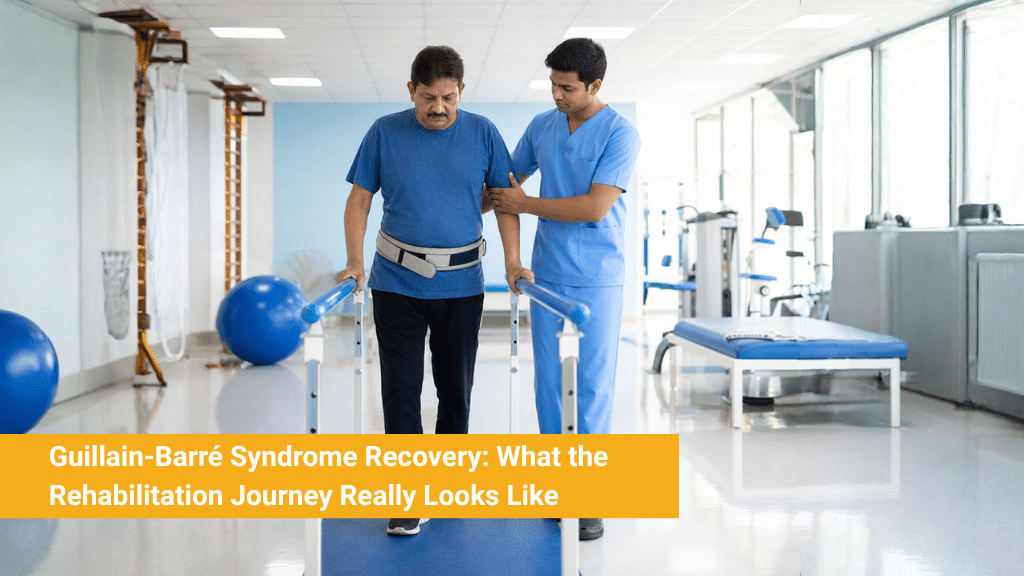
It changes at every stage. Early on it is passive – the therapist moves the patient’s limbs to maintain the range of motion and prevent stiffness. As strength returns, exercises become active and progressively demanding: sitting balance, standing, transfers, walking with and then without support. The rate of progression is set by the patient’s fatigue levels, not a fixed schedule.
GBS-related fatigue is neurological in origin, not just physical deconditioning. It is the nervous system recovering from an attack, and it does not disappear once the muscles are working again. Many patients find that fatigue is the last thing to resolve and for some it never fully does. A rehabilitation team that understands this will build fatigue management strategies into the programme from the start, not treat it as a complaint to push through.
As a staged, multidisciplinary process that changes as the patient changes. Sukino’s teams in Bangalore and Kochi work with GBS patients from the acute phase through to community reintegration – adjusting physiotherapy, occupational therapy and respiratory support in step with recovery, while making sure fatigue, pain, and emotional wellbeing are tracked alongside physical progress.


