


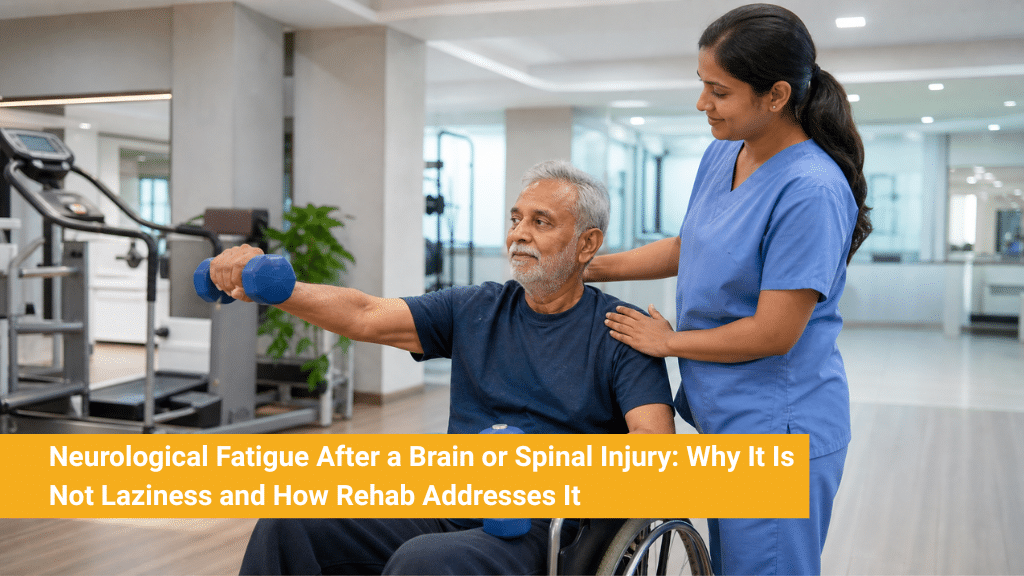
Many people recovering from a stroke, brain injury, spinal cord injury, multiple sclerosis, or Guillain-Barré Syndrome experience overwhelming fatigue. Families often mistake this for laziness or lack of motivation, but neurological fatigue is a real medical condition that requires proper management and rehabilitation. It is also, in clinical and domestic settings alike, one of the most consistently misread and is attributed to low motivation, depression, or simply insufficient effort from a patient who could do more if they chose to.
That attribution is clinically incorrect, frequently harmful, and a reliable predictor of poor rehabilitation outcomes. Neurological fatigue is a physiological condition with identifiable mechanisms. It responds to specific interventions. And it is significantly worsened by the pressure to push through it. You can consider it a well-intentioned response that produces the opposite of the intended effect.
What Neurological Fatigue Actually Is
In a neurologically healthy person, the brain generates movement, thought and communication through neural pathways. After injury (whether from stroke, trauma, demyelination, or peripheral nerve damage) those pathways are disrupted. The brain must now route signals through damaged or alternative circuits, recruit additional neural resources, and sustain far more effort to produce outputs that were previously automatic.
The result is disproportionate exhaustion to the activity. It is a phenomenon that is physiological in origin and not volitional by any means. A patient who cannot sustain a ten-minute conversation or who needs two hours of rest after a short walk, is not being difficult. The nervous system is depleted in a way that has nothing to do with willingness.
Neurological fatigue presents in three distinct but overlapping forms, each requiring different management approaches:
The three types of neurological fatigue and how to recognise each:
- Central fatigue: Originates in the brain itself. The injured nervous system must work far harder than before to generate the same output – the cognitive or physical effort that was once automatic now requires conscious, effortful processing. The result is exhaustion disproportionate to the activity performed.
- Peripheral fatigue: Occurs in the muscles – disrupted nerve signalling means muscles receive less efficient commands and tire more rapidly than they would in a neurologically intact person. Common in GBS, MS, and spinal cord injury.
- Cognitive fatigue: Mental tasks like following a conversation, reading, and making decisions require the injured brain to recruit additional neural resources. The cost is exhaustion after cognitive effort that would have been effortless before. Often the most socially disabling form, because it is entirely invisible.
How Neurological Fatigue Presents Across Conditions
The nature and severity of neurological fatigue depend on the condition, the location of injury & the stage of recovery:
Condition | Fatigue Pattern and Clinical Significance |
Stroke | Central and cognitive fatigue; often worst in the first six months; affected by depression, sleep disruption and the cognitive effort of compensating for deficits |
Traumatic Brain Injury | All three types frequently present together; cognitive fatigue is often the most persistent and disabling; strongly linked to reduced therapy engagement |
Multiple Sclerosis |
|
GBS | Peripheral fatigue dominates during recovery; central fatigue emerges as neurological repair proceeds; can persist for years after apparent physical recovery |
Spinal Cord Injury |
|
Parkinson’s Disease | Central fatigue distinct from motor symptoms; not always related to disease severity; poorly responsive to dopaminergic medication; requires specific management strategies |
Neurological Fatigue Is a Clinical Problem. It Needs a Clinical Response.
At Sukino fatigue management is not an afterthought once physical milestones have been met. It is assessed, tracked, and addressed as a primary component of every neurological rehabilitation programme because fatigue that is not managed does not plateau. It limits everything else.
If your loved one is experiencing neurological fatigue after a brain or spinal injury, specialised rehabilitation can help improve energy management and recovery outcomes. Contact Sukino's neuro rehabilitation team to learn more.
Call us or visit sukino.comWhy 'Pushing Through' Neurological Fatigue Does Not Work
The instruction to push through fatigue is appropriate for deconditioning after a period of ordinary illness where graded effort rebuilds capacity. Applied to neurological fatigue, pushing produces a pattern doctors refer to as boom and bust – the patient overexerts on a day when energy is relatively available, triggers a significant worsening of symptoms and then spends several days in a depleted state that sets back overall progress.
Families who urge patients to do more (it may be a genuine concern that inactivity will slow recovery) inadvertently drive this cycle. The clinical alternative is not rest but a sustainable activity level which builds from there incrementally and without triggering post-exertional deterioration.
How Rehabilitation Addresses Neurological Fatigue
Effective fatigue management in neurological rehabilitation is multi layered. It requires assessment, strategy, family involvement and consistent implementation across the full day and not something that is limited to therapy sessions.
How rehabilitation manages neurological fatigue:
- Activity-rest cycles: Prevent the boom-bust pattern of overdoing then crashing
- Energy conservation: Identifying which tasks cost the most cognitive or physical resources and reorganising the day accordingly
- Graded exercise: Calibrated physical activity that gradually builds tolerance (without triggering post exertional worsening)
- Cognitive rehabilitation: Reducing the neural effort required for compensatory strategies lowering the cognitive fatigue load
- Sleep hygiene: Addressing the sleep disruption that is nearly universal after neurological injury and dramatically worsens fatigue
- Pain and spasticity management: Because uncontrolled pain and spasticity are independent fatigue multipliers
- Psychological support: Depression and anxiety amplify fatigue by a lot therefore treating them reduces the overall burden.
- Family and caregiver education: Ensuring the home environment supports pacing rather than undermining it
FAQs
Ordinary tiredness after illness resolves with rest and improves as your body heals. Neurological fatigue is disproportionate to the activity that caused it. It does not fully resolve after sleep & can be triggered by a simple activity like a conversation, reading a page or following a television programme. It originates in the nervous system. Rest helps temporarily but does not cure it.
No and in some conditions it actively worsens it. Post exertional malaise, where symptoms worsen significantly following physical or cognitive effort beyond tolerance is a symptom of several neurological conditions including acquired brain injury and MS.
For many patients, fatigue is most severe in the first three to six months and improves a lot by the end of the first year. For others it persists as a long-term feature of life after injury. It may be present at lower intensity but requiring ongoing management.
Encouragement is valuable but pressure is counterproductive. Families who interpret fatigue as avoidance and push the patient to do more – out of genuine concern for recovery – frequently cause setbacks and damage the patient’s trust in the process. The right response is to understand what level of activity the rehabilitation team has prescribed, support the patient in maintaining that level consistently, and raise concerns about fatigue with the clinical team rather than resolving them independently.
We manage it as a primary condition and not a secondary complaint. Here fatigue is assessed at admission and tracked throughout rehabilitation. Pacing strategies are built into the daily programme. Sleep, pain, spasticity, and psychological state are all monitored as fatigue modulators. Family education specifically addresses fatigue management at home because the gains made in rehabilitation are only sustained if the environment the patient returns to understands and supports them.


