
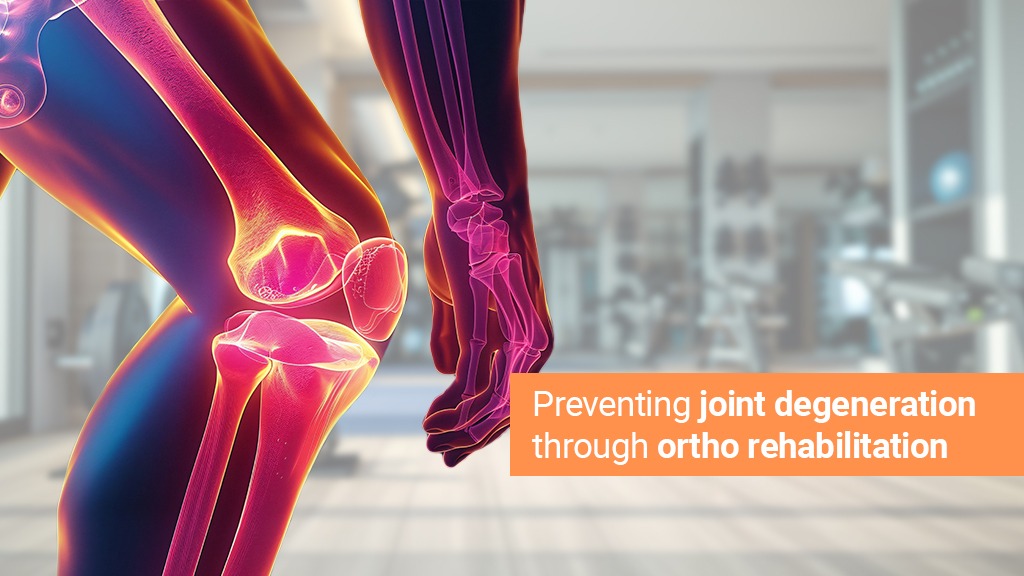
Preventing Joint Degeneration Through Ortho Rehabilitation
Here’s something that we all miss. You may be mistaking that stiffness and pain in your body as an age-related issue, but experts have an important question to ask. “Are you listening to your joints?” They believe that they may be the early signs of joint degeneration in the body in most instances.
The positive side is that although degeneration of the joints is not unavoidable, its progression can be slowed, controlled, and even avoided with the appropriate intervention, particularly orthopaedic rehabilitation.
Degeneration of the joints
The gradual weakening of the cartilage, the smooth and protective tissue that cushions the bones and allows the bones to move painfree is referred to as joint degeneration. Wear and tear of cartilage leads to stiffness, pain, and inflammation of the joints, which, in the end, makes movements difficult.
Common causes include:
- Age-related wear and tear.
- History of prior injuries or fractures.
- Bad posture and body movements.
- Weakness or loss of equilibrium in muscles.
- Sedentary lifestyle.
- Obesity and overload of the joints.
In its untreated format, degeneration may develop into diseases, such as osteoarthritis, and have a huge impact on mobility and quality of life.
Why early action matters
It is a progressive degeneration of the joints that means that they deteriorate when not treated. Early intervention can:
- Reduce pain and stiffness.
- Improve joint alignment.
- Guard against loss of cartilage.
- Postpone or evade surgery.
- Maintain an active and independent status.
It is here that orthopaedic rehabilitation is important.
What Is Ortho Rehabilitation?
Orthopaedic rehabilitation is a type of therapy that aims at recovering and maintaining the well-being of bones, joints, muscles, and ligaments. It is not just after surgery to recover, but it is equally effective in avoiding the destruction of the joint that can become serious.
Ortho rehab is a combination of:
- Targeted exercise therapy.
- Manual therapy techniques.
- Postural correction.
- Movement re-education.
- Pain management strategies.
- Ergonomic and lifestyle instructions.
Ortho rehabilitation and prevention of joint degeneration
1-Increases muscle strength that aids the joints
Powerful muscles shock-absorb and lessen the strain on the joints. Weak muscles compel joints to carry extra weight, which increases the rate of wear and tear.
Rehabilitation aims at working on:
- Knee protectors: Quadriceps and hamstrings.
- Muscles of the spine and hip stability: Gluteal and core muscles.
- Shoulder stabilizers for proper upper limb function.
The strength of muscles is balanced, which helps joints to move with efficiency and safety.
2-Enhances mechanics and anatomy alignment
Bad posture and incorrect movement patterns cause unequal pressure on the joint surfaces. In the long term, it results in an accelerated cartilage degeneration.
Ortho rehab corrects:
- Gait abnormalities.
- Postural issues.
- Movement compensations.
- Muscle imbalances.
Sturdier mechanics imply a reduced level of friction and healthier functioning of the joints.
3-Increases flexibility and joint mobility
The stiff joints are more susceptible to injury and degeneration. Mobilization and stretching exercises enhance range of motion, decrease stiffness, and facilitate joint nourishment by movement. Light workouts involving movements keep the joints lubricated.
4-Lessens the suffering without being dependent on meds.
The consequential effect of pain is that it affects activity, which further deteriorates degeneration. Non-pharmacological methods of pain relief are employed in rehabilitation
They include:
- Therapeutic exercises.
- Manual therapy.
- Heat or cold therapy.
- Activity modification.
Rehab promotes safe movement and active recovery by dealing with the cause of pain.
5- Weight control and load shedding
Being overweight causes a lot of stress on the joints, especially the knees, hips, and spine. Ortho rehabilitation offers physical exercises that maintain weight conditions.
Even small weight loss can have a tremendous impact on decreasing the load on the joints and delaying degeneration.
6-Eliminates re-Injury and additional damage
A significant risk factor of degeneration of the joints is previous injuries. Ortho rehab assists in regaining strength, stability, and coordination, which lessen chances of re-injuries.
Who can benefit from ortho rehabilitation?
Orthopaedic rehabilitation can help:
- People with a sore or stiff joint at an early age.
- Individuals who lead sedentary lifestyles.
- Elderly with low mobility.
- Patients with joint injuries.
- Early osteoarthritis patients.
- Patients with discomfort of the posture.
It is not about waiting until the pain is bad, but acting at an early stage.
The lifestyle education role
Ortho rehabilitation is also aimed at teaching the patients how to save their joints in everyday life through:
- Correct lifting techniques.
- Correct sitting and sleeping position.
- Activity pacing.
- Ergonomics on the job and at home.
Such minor interventions allow for avoiding unnecessary tension and contribute to the overall well-being of joints in the long term.
The process of joint degeneration prevention does not involve quick remedies but rather the development of a habit that would protect the joints in the long run. Ortho rehabilitation provides the person with the ability, knowledge, and self-assurance to remain active and self-reliant.
When joints are treated with efforts of early intervention, directed movement, and professional rehabilitation, they remain strong, flexible, and active well into the future.
In Sukino, orthopaedic rehabilitation is not only aimed at the reduction of pain, but also the maintenance of movement, independence, and quality of life. Protecting your joints nowadays means being free tomorrow.
BY: Sukino
COMMENTS: No Comments