


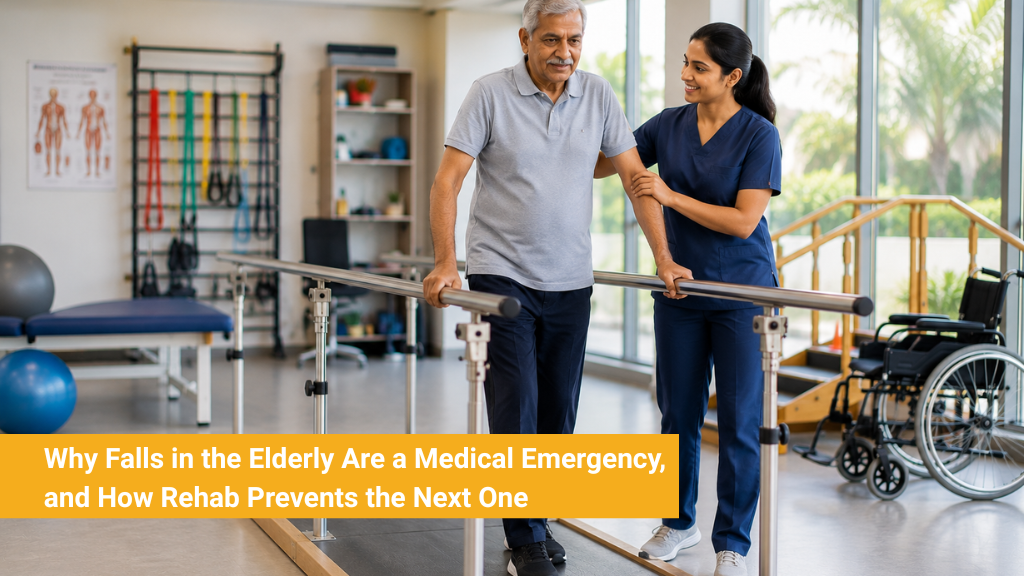
A fall in an older adult is rarely just a fall. It is, in clinical terms, a sentinel event or a signal that something in the body’s systems has changed enough to compromise balance, strength or awareness, and a strong predictor that another fall will follow unless that underlying cause is identified and addressed. Treating a fall as an isolated accident, something to be patched up and moved past, is one of the most consequential mistakes families and even some clinicians make in post-acute care. The medical reality is starker: a fall after the age of 60 should be treated with the same seriousness as a cardiac event, because the consequences, both immediate and downstream, can be just as severe.
Why a Fall Is Classified as a Medical Emergency
The immediate injuries from a fall such as hip fractures, head trauma, wrist fractures are well understood as emergencies. What is less understood is that the fall itself, even without a major fracture, represents an emergency in physiological terms. A fall indicates that one or more of the systems responsible for staying upright (vision, vestibular function, muscle strength, joint proprioception, cardiovascular regulation, or cognitive processing speed) has failed at the moment it was needed.
Hip fractures deserve particular attention in older adults. The fracture with prolonged immobility, pneumonia, blood clots, pressure injuries and the rapid deconditioning make recovery progressively harder (the longer it is delayed).
Head injuries from falls carry their own urgency, particularly in older adults taking blood-thinning medication. A fall that produces no visible injury can still cause a slow intracranial bleed that takes hours or days to become symptomatic. Any fall involving the head in a patient on anticoagulants warrants immediate medical evaluation regardless of how the patient appears afterwards.
When a Fall Needs Immediate Medical Attention
- Any head injury in a patient taking blood-thinning medication – even with no visible injury
- Inability to bear weight or stand without significant pain
- Visible deformity, swelling, or bruising at a joint
- Confusion, drowsiness, or slurred speech following the fall
- Loss of consciousness at any point during or after the fall
The Hidden Danger: Fear of Falling Again
The psychological aftermath of a fall is frequently underestimated yet it shapes recovery as much as the physical injury does. Many older adults develop a pronounced fear of falling after even a minor incident and this fear is not irrational caution (rather it becomes a clinical problem in its own right).
This fear drives a pattern that clinicians call activity restriction. The person who fell begins avoiding the situations associated with the fall:
- Walking without support.
- Climbing stairs.
- Leaving the house alone.
This avoidance (while protective in the short term) accelerates the very deconditioning that increases fall risk. Muscles weaken further and balance reactions slow further. The person becomes more likely to fall again because they have stopped doing the activities that maintained their physical reserve.
Families frequently describe watching a parent or grandparent withdraw after a fall (declining outings, insisting on staying seated or becoming reluctant to move around the home independently). This withdrawal is mistaken for caution or ageing but they are a treatable consequence of the fall itself.
What Causes Falls in Older Adults
Falls are rarely caused by a single factor. They typically result from the intersection of several risk factors that compound each other.
Risk Factor | Why It Increases Fall Risk |
Muscle Weakness (Sarcopenia) | Reduced leg and core strength impairs the ability to catch a stumble before it becomes a fall |
Medication Effects | Sedatives and blood pressure medications can cause dizziness, drowsiness or low blood pressure on standing |
Vision Changes | Reduced depth perception & contrast sensitivity make uneven surfaces harder to detect |
Home Environment | Loose rugs, poor lighting and cluttered walkways account for most indoor falls |
Balance & Gait Changes | Subtle shifts in stride and foot clearance often precede a fall by months, unnoticed by family |
How Structured Rehabilitation Prevents the Next Fall
The single most effective fall prevention intervention available is not a home modification or a walking aid, although both matter. It is structured, progressive rehabilitation focused specifically on the strength, balance and gait deficits that caused the fall in the first place.
Balance training that progressively challenges stability under professional supervision with appropriate safety measures gives improvements in fall risk within weeks. This is not a generic exercise. You can think of it as a targeted retraining of the specific systems that failed. Strength training particularly for the hip and leg muscles responsible for catching a stumble before it becomes a fall, directly addresses the sarcopenia that underlies so much fall risk in this population.
Gait retraining addresses the subtle changes in walking pattern that often precede a fall by months (a shortened stride, reduced foot clearance, asymmetry between sides). These changes are frequently invisible to family members but are exactly what an experienced rehabilitation team is trained to identify and correct.
What a Comprehensive Fall-Risk Assessment Involves
A proper post-fall assessment goes well beyond treating the immediate injury. It includes a structured evaluation of gait and balance, a review of all current medications for fall-risk contributors, vision assessment, cardiovascular screening for conditions that cause dizziness on standing and a home safety evaluation. Skipping this assessment after a fall (treating only the fracture or the bruise and sending the patient home) leaves the underlying cause unaddressed and the second fall, statistically, far more likely.
Recovery After a Fall-Related Injury
Recovery following a significant fall-related injury, particularly a hip fracture, requires the same multidisciplinary intensity as recovery from a stroke or cardiac event. Early mobilisation, carefully managed pain control and progressive weight-bearing rehabilitation under clinical supervision all influence whether the patient returns to their prior level of independence or experiences a permanent decline in function.
The window for this rehabilitation matters considerably. Patients who begin structured therapy immediately after injury rather than waiting for complete healing before any activity begins, consistently show better functional outcomes. Deconditioning during the waiting period is rapid in older adults and every week of inappropriate inactivity makes the eventual rehabilitation longer and more difficult.
A fall is not the end of an older adult’s independence but treating it as a minor incident rather than the medical emergency it is increases the odds that it becomes exactly that. Structured assessment and rehabilitation, started early and pursued seriously, are what stand between one fall and a second, more serious one.
FAQs
Because the fall itself signals that a critical system (balance, strength, vision or cardiovascular regulation) has failed. Even falls without visible injury warrant assessment since the underlying cause, left unaddressed, makes a second and potentially more serious fall likely.
This is a recognised clinical pattern called fear of falling, which leads to activity restriction. Avoiding movement feels protective but accelerates muscle weakness & balance decline, which paradoxically increases the risk of a future fall.
A structured evaluation of gait and balance, a medication review for fall-risk contributors, vision assessment, cardiovascular screening for dizziness and a home safety evaluation and not just treatment of the visible injury.
Yes targeted balance training, strength training for the hip and leg muscles and gait retraining produce measurable reductions in fall risk within weeks when delivered by a trained rehabilitation team.
As early as is medically safe. Waiting for complete healing before starting any movement allows rapid deconditioning, which makes eventual rehabilitation longer and outcomes worse. Early carefully managed mobilisation tends to produce better functional recovery.
No most falls among older adults happen indoors, often due to poor lighting, loose rugs or cluttered walkways.


