


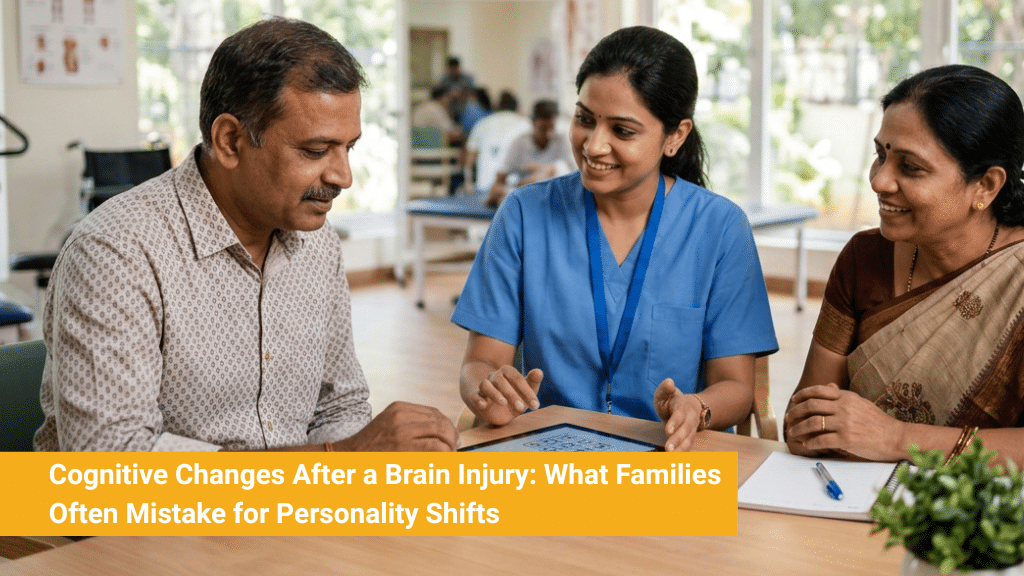
Cognitive changes are among the most disorienting consequences of acquired brain injury. For family members helping patients with recovery these are commonly misattributed. When a person becomes irritable where they were once patient, withdrawn where they were once engaged, or socially inappropriate where they were once considered and thoughtful, the natural interpretation is that something fundamental about who they are has changed.
In most cases that interpretation is clinically incorrect. What you read as a shift in character is more often the symptoms of some neurological deficit (it can be damage to the brain circuits that give you impulse control, emotional regulation, memory and social cognition). Understanding the distinction is not merely academic. It changes how families respond, how rehabilitation is designed, and whether the patient receives the targeted cognitive support that can make a material difference to their trajectory.
The Brain Systems That Govern Behaviour and What Happens When They Are Damaged
The frontal lobes and their connections with the limbic and paralimbic systems are the primary regulators of behaviour, impulse, and emotional expression. When a stroke, traumatic brain injury, or hypoxic brain injury damages these regions or disrupts the white matter pathways connecting them the person loses some or all of the neurological machinery through which they moderate their own conduct.
This is not a psychiatric change but a neurological one. The person has not developed a character flaw or a mood disorder in the ordinary sense. The frontal inhibitory systems that allowed them to pause before speaking, to modulate frustration before it became anger or to read and respond to social cues appropriately have been structurally compromised. What the family sees is the behaviour. What the clinician needs to see is the mechanism.
What Families See and What Is Actually Happening
The following are among the most common post-injury behaviours that families misinterpret as personality change, and the neurological explanation for each:
What Families See | The Cognitive Cause | Why It Is Not a Personality Change |
Irritability and short temper | Reduced impulse control from frontal lobe damage – the brain’s braking system has been compromised | The person has not become angry rather it may be the injury that has removed the mechanism that regulates expression |
Apathy and withdrawal | Damage to motivation circuits, often in the frontal and limbic systems | Frequently misread as depression or indifference, the person may want to engage but lack the neurological drive to initiate |
Inappropriate social behaviour | Reduced social inhibition from orbitofrontal cortex damage – the filter between thought and action is damaged | Bluntness, tactlessness or inappropriate remarks are neurological symptoms, not rudeness or character |
Emotional lability | Disrupted emotional regulation pathways – crying or laughing that feels disconnected from what the person actually feels | The patient is often as distressed by these episodes as the family; it is not manipulation or instability |
Rigidity and resistance to change | Executive dysfunction affecting cognitive flexibility – the brain struggles to shift between tasks or adapt to new information | Insistence on routine or resistance to redirection is a cognitive symptom (friends and families often consider it as stubbornness) |
Memory-driven conflict | Damage to short-term memory systems means the patient may repeat questions, forget conversations, or deny events that occurred | Accusatory or defensive responses to memory failures are a symptom of the injury – not dishonesty or manipulation |
Cognitive Rehabilitation Is Part of Brain Injury Recovery
At Sukino's centres, cognitive rehabilitation is not a separate referral it is embedded in every brain injury programme from admission. Our neuropsychologists, physiotherapists, occupational therapists, and speech-language therapists work to a single coordinated plan, because physical recovery and cognitive recovery are not separate journeys.
If your loved one is managing cognitive changes our specialised neuro rehabilitation can make a significant difference in recovery. Contact Sukino's neuro rehabilitation team to understand what has changed is the first step to addressing it.
Call us or visit sukino.comWhy Naming This Correctly Changes Everything
When a family believes their relative has simply ‘changed’ – become a different, more difficult person – the emotional response is grief, frustration and eventually distance. Interactions become adversarial. The patient, often with limited insight into their own deficits, cannot understand why the people around them are upset. The relationship deteriorates. Recovery suffers.
When the same behaviours are understood as symptoms (neurological deficits with a mechanism and a response) the family’s position shifts. Irritability is not an attack but a frontal regulation deficit. Repetitive questioning is not stubbornness rather it is a memory issue. That reframe does not make the behaviour easier to live with. But it makes an appropriate response possible, and it opens the door to rehabilitation that actually targets the cause.
What Cognitive Rehabilitation Does
Cognitive rehabilitation is the structured, evidence-based process of addressing the specific deficits identified through neuropsychological assessment. It works through two parallel mechanisms: directly stimulating neuroplasticity in affected systems through targeted cognitive exercises, and building compensatory strategies that allow the person to function despite deficits that will not fully resolve. It is rarely a quick process – but it is consistently underutilised in Indian rehabilitation settings, where physical recovery tends to dominate the programme.
What cognitive rehabilitation addresses after a brain injury:
- Attention and concentration – building the capacity to sustain focus and filter distractions
- Memory – strategies to compensate for encoding and retrieval deficits that will not fully resolve
- Executive function – planning, sequencing, decision-making and the ability to shift between tasks
- Processing speed – helping the brain adapt to slower cognitive throughput without social withdrawal
- Impulse control – structured behavioural strategies that compensate for damaged frontal regulation
- Insight and self-awareness – one of the hardest deficits to treat; many patients cannot recognise their own changes
- Emotional regulation – identifying triggers, building coping strategies, reducing the distress of lability episodes
FAQs
Not necessarily and this is one of the most important things families need to understand. The brain retains its capacity for reorganisation and recovery (particularly in the first months after injury) with deficits improving substantially with structured rehabilitation. Others may persist but can be managed with strategies that restore meaningful independence.
It is extremely common and deeply distressing for families. What looks like a changed personality is, in most cases, the external expression of specific cognitive and neurological deficits: reduced impulse control, altered emotional regulation, memory disruption, or damage to the brain systems that govern social behaviour. The person has not fundamentally changed who they are. The injury has disrupted some of the mechanisms through which they express and regulate themselves.
Executive function refers to the higher-order cognitive processes managed by the frontal lobes: planning, organising, initiating tasks, shifting between activities, weighing consequences and regulating behaviour. After frontal lobe injury, these functions are impaired in ways that look like personality traits (laziness, inflexibility, poor judgement, impulsivity). They are not. They are the clinical presentation of damage to specific neural circuits, and they respond to targeted cognitive rehabilitation.
Repetitive questioning after brain injury is almost always a symptom of damage to short-term memory encoding – the process by which new information is transferred into lasting memory. The person asks, receives an answer, and within minutes the exchange has not been stored. They are not asking again to be difficult. The question is genuinely new to them each time. This requires patience from families and specific memory compensation strategies from the rehabilitation team.
They should not wait. Cognitive assessment should begin as part of the acute rehabilitation process – not after physical recovery has plateaued. The same neuroplasticity window that makes early physical rehabilitation more effective applies equally to cognitive recovery. Families who pursue cognitive rehabilitation months after discharge, having focused exclusively on physical recovery initially, are starting later than necessary and losing the period of highest brain responsiveness.
Cognitive changes after brain injury are frequently more disorienting for families than physical ones because they affect relationship, identity and daily interaction in ways that are harder to name. Sukino’s neuropsychologists and care teams take families through the entire process of rehabilitation: explaining what is happening, why it looks the way it does and how families can respond in ways that support recovery rather than inadvertently reinforcing symptoms.


