


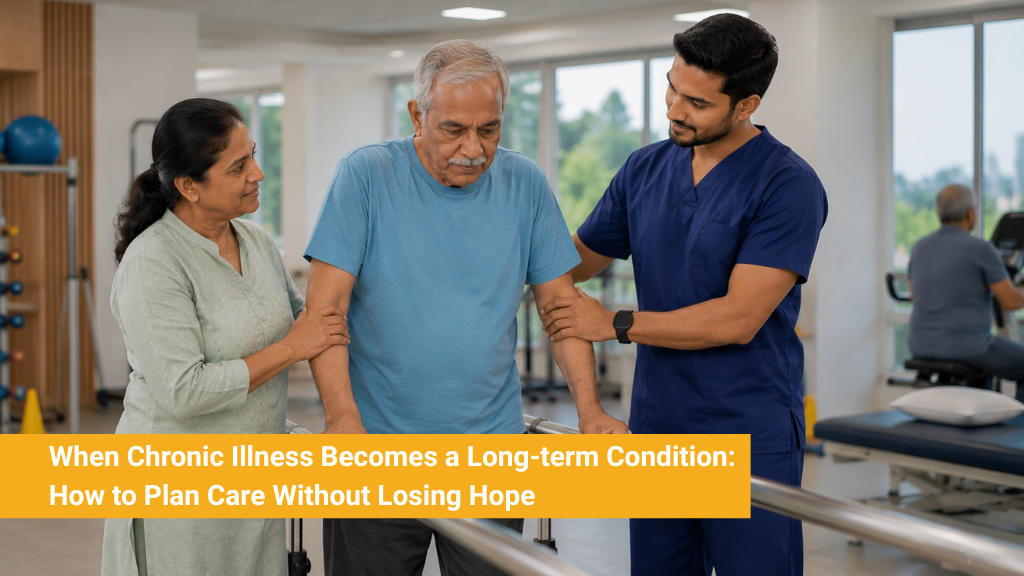
A diagnosis of chronic illness changes the question a family is asking. In the early weeks, the question is usually “how do we fix this?” Over months and sometimes years, that question shifts toward something harder: “How do we live with this?” The transition from treating an acute event to chronic illness management is one of the most difficult adjustments a family makes and it is rarely discussed with the clarity it deserves. Planning care for a long-term condition is not an admission of defeat. It is the structure that allows hope to remain realistic rather than collapsing into either denial or despair.
When Is Long-Term Care Planning Necessary?
Many conditions that begin as acute medical events – stroke, spinal cord injury, traumatic brain injury, advanced Parkinson’s disease, progressive neurological disorders – eventually settle into a different phase. The acute crisis has passed. Active treatment has stabilised what can be stabilised. What remains is a condition that will require ongoing management, not a cure.
This transition is often poorly marked. Families continue operating in crisis mode – searching for the next treatment, the next specialist and the next intervention – well past the point where that orientation serves the patient. Recognising this shift requires honesty from clinical teams & a willingness from families to ask different questions: not “what will reverse this” but “what will make daily life with this condition as full and stable as possible.
What Families Are Rarely Told Directly
- The shift from acute to long-term care is rarely announced clearly by clinical teams – families often have to recognise it themselves.
- Continuing to search for a reversal long after a condition has stabilised can delay the practical planning that actually protects quality of life.
- Grieving a family member who is still alive is a recognised experience, not a sign of giving up on them.
- A long-term care plan is not a downgrade from active treatment – it is a different, equally serious form of clinical commitment.
Why This Transition Is So Difficult
Moving from managing an acute illness to living with a long-term condition is rarely simple, for patients or for the families supporting them. The difficulty goes beyond simply adjusting daily routines and care needs. It also involves coming to terms with a different understanding of the condition itself and what managing it will look like going forward.
For many families accepting that a condition will require ongoing care does not happen overnight. It takes time to process. But planning for long-term management is not about scaling back expectations. It is about building a sustainable approach, one that genuinely supports the person’s health, independence and quality of life over the months and years ahead.
Families often move through a range of emotions as they adjust to changes in health, ability or the future they had originally pictured. Acknowledging these feelings, rather than pushing past them, is an important part of the care journey in itself. Open conversations, realistic goals, and the right support along the way can help families find their footing again and move forward with a steadier, more hopeful outlook.
How to Create a Long-term Care Plan
A long-term care plan addresses four interconnected dimensions: medical management, functional support, financial sustainability and the emotional wellbeing of both the patient and the caregivers. Treating any one of these in isolation tends to produce a plan that fails under pressure.
Medical management for a long-term condition looks different from acute treatment. The goal shifts from cure to optimisation – minimising complications, managing symptoms and preventing the secondary issues (pressure injuries, contractures, recurrent infections, depression) that erode quality of life over time. This requires a different relationship with the clinical team: less urgent, more sustained and built around regular review rather than crisis response.
Functional support means identifying, honestly, what the person can do independently, what they can do with assistance, and what requires full support and building a structure around that reality rather than around hoped-for improvement that may not materialise. This assessment should be revisited periodically, because functional status in long-term conditions can change in either direction, and a plan built on outdated assumptions creates unnecessary strain.
Financial planning for long-term care is frequently avoided until a crisis forces the conversation, which is exactly the wrong time to have it. The costs of long-term rehabilitation, home modifications, ongoing therapy and caregiver support are substantial and sustained. Families who map these costs early are in a far stronger position than families who discover the financial scale of long-term care only when resources are already strained.
Crisis Mode vs a Long-term Plan
Dimension | Crisis Mode Approach | Long-term Plan Approach |
Medical Management | Urgent, reactive, focused on cure or reversal | Sustained, scheduled, focused on optimisation and complication prevention |
Functional Support | Assumes improvement is imminent | Built around current ability, reviewed and adjusted periodically |
Financial Planning | Addressed only when costs become urgent | Mapped early, budgeted across years and revisited regularly. |
Caregiver Role | One person absorbs continuous demand | Shared, supported by respite and professional care at intervals. |
Is your family navigating the shift to long-term care?
Sukino Healthcare partners with families managing chronic and long-term conditions - coordinating rehabilitation, ongoing therapy, and caregiver support so no single person has to hold the plan alone. If your loved one is living with a chronic illness, stroke, Parkinson's disease, brain injury or another long-term condition, Sukino's long-term rehabilitation and care services can help improve quality of life while supporting families through every stage of care. Contact Sukino's rehabilitation team to learn more.
Click HereThe Caregiver's Place in the Plan
Caregiver burnout is one of the most predictable and most preventable failures in long term care planning. A plan that depends entirely on one family member’s continuous availability is not a sustainable plan, regardless of how committed that person is. Respite care, shared caregiving arrangements among family members and professional support at defined intervals are not luxuries – they are structural requirements for a plan to hold over years rather than months.
Caregivers often face an additional pressure: the expectation, deeply embedded in Indian family culture that care should be provided entirely within the family unit. This expectation while rooted in genuine devotion frequently results in caregivers (most often spouses or adult children) absorbing a level of physical and emotional strain that becomes unsustainable. Acknowledging that professional support strengthens rather than replaces family care is an important reframe for many households.
Where Hope Fits Into a Long-term Plan
Hope, in the context of long-term illness, needs redefinition. It is not hope for a cure that may not come. It is hope for stability, for meaningful days, for relationships that continue to have depth despite the constraints of illness, for a life that has structure and dignity even when it does not have the trajectory that was once expected.
Working With a Long-term Care Partner
Long-term conditions are rarely managed well by a single clinical relationship. They require a coordinated structure: rehabilitation specialists who understand the specific condition, ongoing therapy that adapts as functional status changes and a point of continuity that prevents the family from having to rebuild context with a new provider at every stage.
This is the role that structured post-acute and long-term care providers are built to play – not as a single intervention, but as a sustained partnership that holds the medical, functional and emotional dimensions of care together as circumstances evolve. Families navigating this transition do not need to build the entire structure alone.
The shift from acute crisis to long term condition is not the end of meaningful progress. It is the beginning of a different kind of progress – one measured in stability, dignity and sustained quality of life rather than in reversal. Planning for it honestly is the most hopeful thing a family can do.
FAQs
Generally when active treatment has stabilised what can be stabilised and the clinical focus moves from reversal to management. This is a clinical judgement best made jointly with the treating team but families often sense it when the search for a fix stops yielding progress.
No many long-term conditions still allow for gradual functional gains especially with consistent rehabilitation. Planning for the long term simply ensures that hope is paired with a structure that protects quality of life regardless of how much improvement occurs.
It is the cumulative physical & emotional exhaustion that results from sustained, unsupported caregiving. It is one of the most common reasons long term care plans collapse. Shared caregiving and scheduled respite are protective.
Continuity. Rather than families rebuilding context with a new provider at every stage, a structured care partner holds medical management, rehabilitation and emotional support together as the person’s needs evolve over months and years.
Yes in many cases. With neurological conditions and other post-acute illnesses, functional improvements can continue well beyond the initial recovery window especially when rehabilitation remains consistent and is targeted to the person’s specific needs. This is exactly why periodic functional reassessment matters.


