


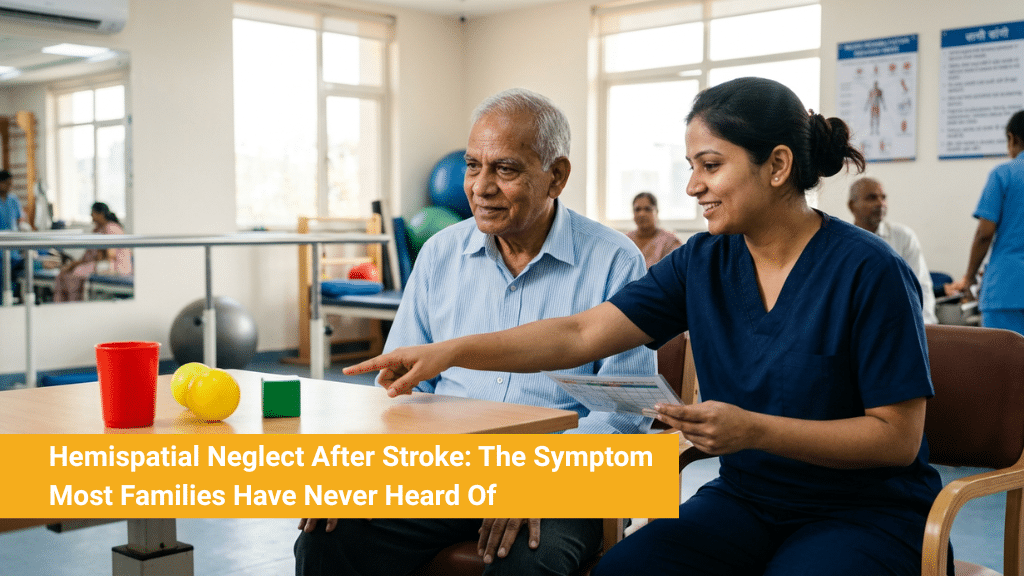
Hemispatial neglect is a neurological condition that follows stroke in a significant proportion of patients; most commonly those who have suffered damage to the right hemisphere. It is not a problem with the eyes. The patient can, in many cases, see perfectly well. What they cannot do is attend to (register, process, or respond to) anything on the left side of their world. The left half of the plate. The left side of a face. The left arm lying on the bed beside them.
What Hemispatial Neglect Actually Is
The human brain does not passively receive everything in its environment equally. It allocates attention – directing cognitive resources toward relevant stimuli and filtering out less relevant ones. The right parietal lobe plays a disproportionate role in this process, managing spatial attention across both sides of the world. When a stroke damages the right hemisphere, this attentional system fails for the left side of space.
The patient does not see nothing on the left. In many cases, if a stimulus on the left side is large enough, sudden enough, or salient enough, it breaks through into awareness. What is missing is the spontaneous, automatic direction of attention toward the left. The brain’s map of the world has a gap and the patient does not know the gap is there. That absence of awareness is the defining clinical feature of neglect, and the thing that makes it so difficult for families to understand.
How Hemispatial Neglect Presents After Stroke
The presentations are consistent enough that families, once told what to look for, often realise the signs have been present for weeks.
How hemispatial neglect presents – what families observe:
- Eating only from the right side of the plate, leaving the left half untouched and appearing unaware it exists
- Shaving, applying makeup, or dressing only the right side of the body without noticing the omission
- Reading from the middle of the page, missing entire words or lines on the left
- Colliding repeatedly with door frames, furniture or people on the left side
- Turning the head consistently to the right during conversation, even when addressed from the left
- Drawing a clock face with all twelve numbers crowded onto the right side
- Denying that the left limb belongs to them, or expressing indifference to obvious weakness on the neglected side
Hemispatial Neglect vs Visual Field Loss: A Critical Distinction
These two conditions are frequently confused. Let us understand the difference between the two:
Feature | Hemispatial Neglect | Visual Field Loss |
What is missing | Awareness of one side of space – the brain does not register what is there | Sight in part of the visual field – the eye does not receive or transmit the image |
Patient insight | Often absent – the patient is frequently unaware anything is wrong | Usually present – the patient knows they cannot see from one side |
Compensatory turning | The patient does not spontaneously turn to the neglected side | The patient learns to turn toward the blind side to compensate |
Which stroke causes it | Most commonly a right hemisphere stroke – causing left-side neglect | Depends on where the visual pathway is damaged; can follow any hemisphere |
Rehabilitation approach | Alerting, cueing, prism adaptation, scanning training, limb activation | Scanning strategies, environmental adaptation, mobility training |
Hemispatial Neglect Requires Specialist Stroke Rehabilitation
At Sukino, hemispatial neglect is assessed as a standard component of every right hemisphere stroke admission. Our neuropsychologists, occupational therapists, and physiotherapists work to a coordinated plan - identifying the severity of neglect, selecting the right combination of techniques, and training families in how to support recovery at home without reinforcing the deficit.
Contact Sukino's neuro rehabilitation team to learn more.Why Patients with Neglect Often Cannot See It in Themselves
One of the most clinically challenging aspects of hemispatial neglect is anosognosia – the patient’s unawareness of their own deficit. Because the attentional system itself is damaged, the brain has no reliable mechanism through which to detect the gap in its own awareness. A patient with left-sided neglect who is shown their untouched left arm may acknowledge it intellectually but not register it as a part of themselves that requires attention.
It is a neurological symptom – the brain’s spatial representation system is impaired in a way that prevents self-detection of the impairment. Families who argue with patients about what they should be seeing, or who interpret the lack of insight as wilful non-compliance, are responding to a clinical symptom as though it were a behavioural choice. Rehabilitation specifically addresses insight deficits as part of the treatment plan.
How Rehabilitation Addresses Hemispatial Neglect
Neglect does not resolve by waiting. Without targeted rehabilitation, patients habituate to their altered experience of space, compensation patterns become entrenched and the attentional deficit persists or worsens. Structured rehabilitation works by repeatedly engaging the brain’s attentional system from the neglected side stimulating neuroplastic reorganisation over time.
Rehabilitation techniques used to address hemispatial neglect:
- Visual scanning training: Structured exercises teaching the patient to systematically sweep attention across the neglected side
- Limb activation: Using the movement of the affected left limb to draw attention toward the neglected space
- Prism adaptation: Wearing prism glasses that shift the visual field rightward prompting the brain to compensate leftward over time
- Alerting and cueing: Environmental cues (a red line on the left of the plate, a coloured marker on the left of the page) that prompt the patient to direct attention
- Mental imagery training: Guided visualisation of the neglected space to stimulate the brain’s representational map
- Trunk rotation exercises: Redirecting the body’s midline orientation toward the neglected side
- Occupational therapy: Adapting daily tasks (eating, dressing or reading) so that neglect is systematically challenged rather than accommodated
- Family training: Teaching caregivers to approach from the neglected side, position objects strategically and avoid compensating in ways that reinforce the neglect
FAQs
Hemispatial neglect most commonly follows a right hemisphere stroke particularly damage to the right parietal lobe, which plays a central role in spatial attention and the brain’s internal map of the surrounding world. The right hemisphere manages attention to both sides of space; the left hemisphere manages attention primarily to the right. When the right hemisphere is damaged, the left side of space falls outside conscious awareness. Left hemisphere strokes can cause right-sided neglect, but this is significantly less common and tends to be less severe.
No, and the distinction matters considerably for rehabilitation. Visual field loss after stroke means the eye or optic pathway is damaged – the patient cannot see from one side but knows it, and typically learns to compensate by turning toward the blind side. In hemispatial neglect, the eyes are often physically intact. The problem is in the brain’s attentional system – it fails to register stimuli on the neglected side even when they fall within the visual field. Patients with neglect do not turn toward the affected side because they are not aware there is anything there to turn toward.
Many patients show significant improvement, particularly in the first three to six months following stroke. Mild to moderate neglect frequently resolves substantially with structured rehabilitation. Severe neglect is more persistent and may require longer-term management strategies rather than full resolution. Early, intensive rehabilitation that specifically targets neglect rather than a general programme that does not account for it – produces consistently better outcomes. Waiting to see if it resolves on its own is not a clinically sound approach.
Significantly and in ways that are not always obvious. A patient with left-sided neglect may walk into door frames on the left, fail to notice a hot surface on that side, overlook food on the left of the plate and lose weight, or not register a person standing on their left during a conversation. Falls risk is substantially elevated. Families need to understand the condition well enough to modify the home environment – approaching from the right, placing important items on the right, positioning the bed so the room opens to the right without inadvertently eliminating the challenges that rehabilitation needs to introduce.
This is a phenomenon called somatoparaphrenia – an extension of neglect in which the patient not only fails to attend to the left limb but actively disowns it. It reflects damage to the brain’s body schema: the internal representation of one’s own body and its relationship to space. It is not a delusion in the psychiatric sense and should not be treated as such. It is a neurological symptom, and while it is deeply disorienting for families to witness, it is clinically explicable and, in many cases, responds to rehabilitation.
Substantial and requiring specific guidance. Families who naturally compensate for the neglect by always approaching from the right, always placing objects on the right and always completing tasks on behalf of the patient are inadvertently reinforcing the deficit. Good rehabilitation trains families to introduce the neglected side deliberately – approaching from the left, placing conversation partners on the left, positioning items so the patient must cross the midline to reach them. This is counterintuitive and takes practice. It is also one of the most powerful things a family can do.
Yes we assess hemispatial neglect as a standard component of every right hemisphere stroke admission, not a specialist referral triggered only when families report obvious symptoms. Sukino’s neuropsychologists and occupational therapists use validated clinical assessments to identify neglect, grade its severity, and design a rehabilitation plan that addresses it directly – combining scanning training, limb activation, prism adaptation, and family education within the broader stroke recovery programme.


