
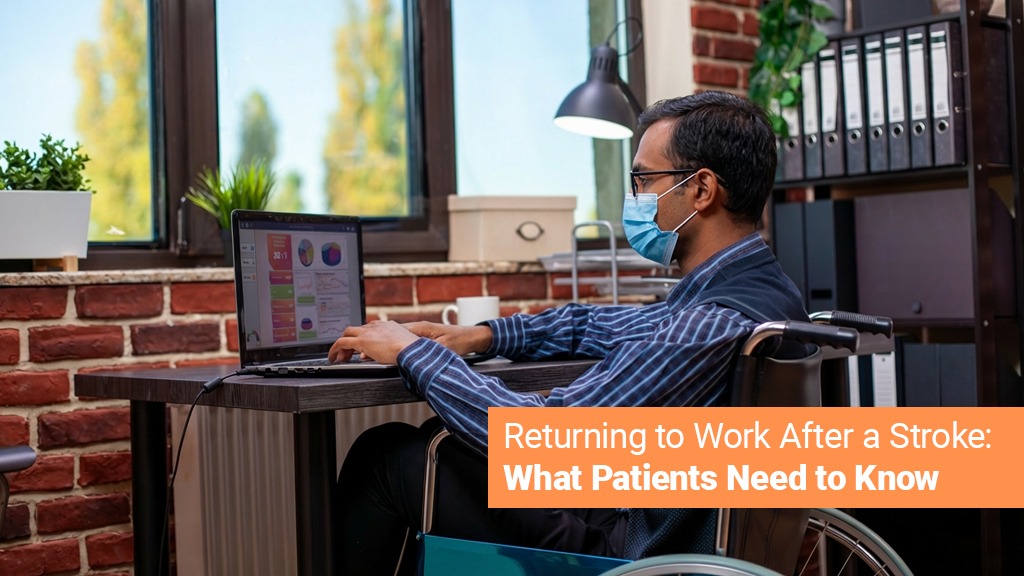
Returning To Work After A Stroke- What Patients Need To Know
A stroke transforms life in a day. One day, it is going around the daily routine, and the next moment, all has changed, including the body and mind. During the weeks and months to come, patients can be seen struggling against a combination of hope, fear, uncertainty, and
determination. And among the largest question that arises in the process of recovery is :
Can I ever go back to work again?
The fact is that a significant number of survivors of strokes can go back to work, and many of them manage to do it well. However, it is not only a physical challenge. It is about being able to restore confidence, retrain skills, and prepare to work in an environment that could look
very different from how it used to be. Through proper guidance and rehabilitation, this settling time towards professional life can be easier, safer, and more empowering.
The blog allows patients and families to learn the actual ways to go back to work post-stroke and the importance of rehabilitation in that process.
Realizing that healing is a slow and steady process.
The recovery process of each individual is varied after a stroke. Some can resume work in a few weeks, while others can take months, or even a year,
before they are fit to work again. The most important thing is to realize that the process of healing occurs in stages.
The rehabilitation team will determine the following:
● Physical (movement, coordination, endurance).
● Thinking abilities (planning, reasoning, decision making).
● Communication skills (speech, language, comprehension).
● Emotional preparation (stress management, confidence, motivation).
All these are the factors that dictate the speed and safety with which one can go back to work. Hurrying up may cause exhaustion, demotivation, or even health failure. Hence, it is essential to take it slow and believe in the rehabilitation plan that has been developed.
The rehabilitation role
Most stroke patients underrate the role of rehabilitation in making them fit to work. Here’s how rehab can help.
1-Physical therapy
Stroke survivors might find it difficult to sit or even stand and walk or even lift something, as this may be physically demanding at the start of work. Physical therapists contribute to the improvement of:
● Balance and coordination.
● Muscle strength.
● Resilience to long working hours.
● Fine motor skills (when they work with tools or computers).
Such developments are critical to preventing injuries or overwork in the workplace.
2-Occupational therapy
Occupational therapists(OTs) assist in re learning the tasks that are needed in order to work both at home and at the workplace. This may include:
● Typing and writing.
● Managing files or tools.
● Multitasking.
● Problem-solving.
● Using adaptive equipment.
OTs can create a mock work environment for practice before patients go back to the real work environment.
3-Speech and cognitive therapy
In case memory, attention, and concentration, or communication have been affected by stroke, the therapists strive to restore these abilities. This is particularly essential for:
● A career where customers are involved.
● High-level work that involves making decisions or planning.
● Communication-heavy professions.
Cognitive rehabilitation is used to enhance the thinking abilities required for coping with work stress and managing tasks.
Choosing when one is ready to go back
The team of rehabilitation professionals conducts structured tests to find out when a person is fit to work and in what capacity. A person is capable of resuming work when they can:
● Perform full-day duties on their own.
● Reach and get out of the office safely.
● Complete simple cognitive tasks without being too tired.
● Have endurance for a number of hours.
● Are confident in speaking.
● Self-regulate stress without arousal of physical symptoms.
The team may also suggest a graded back-to-work plan, in which a person starts with fewer hours or less demanding tasks and steps up.
Facilitating the return and discussing with the employer
The return can be facilitated by many changes at the workplace. One can request:
● Flexible working hours.
● Work-from-home options.
● Reduced workload initially.
● Frequent short breaks.
● Assistive equipment (key boards, voice assistives, ergonomic chairs).
● Modified job duties.
The majority of employers are ready to assist stroke survivors when they are aware of the health requirements. Official documentation to support these adjustments can be provided by the rehab team or the physician.
Handling fatigue and emotional well-being
Fatigue is one of the largest problems stroke survivors encounter at the workplace. The body could require more energy to carry out the things that initially seemed easy, even after physical healing. They can be managed by:
● Taking regular breaks.
● Distribution of activities during the day.
● The prevention of stressful multitasking.
● Improving sleep habits.
● Energy saving practices acquired at rehab.
Emotional health is also an issue. The anxiety or fear of judgment may happen when it’s time to return to work. Support groups, communication with a therapist, or family members can help people feel confident again.
Going back to work after having had a stroke is not a competition, but an individual process.
There are days when it will be more difficult than others. Certain activities might not be completed as fast as they once were. And that’s okay.
What matters is progress.
Every accomplishment, such as sitting longer and doing things alone, is a triumph. In the long term, most of the people who have survived not only get back to their jobs but also get a new meaning of purpose and strength.
BY: Sukino
COMMENTS: No Comments