


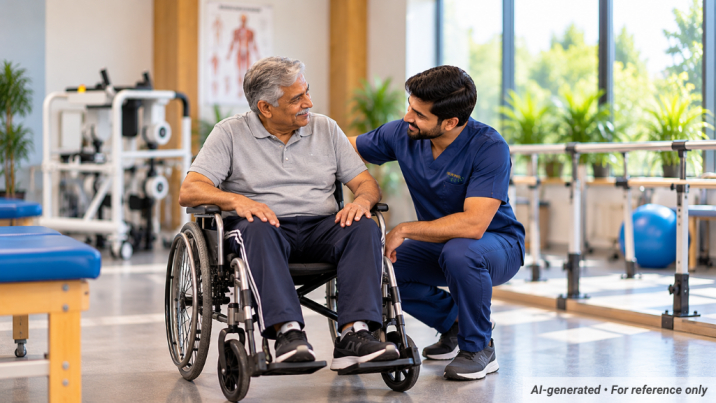
Living with paraplegia can bring major changes to the way a person moves, works, communicates and manages everyday life. Tasks that once seemed automatic – getting out of bed, transferring to a wheelchair, moving around the home or getting dressed may suddenly require new skills and greater effort.
The journey after a spinal cord injury is different for every person. The level and completeness of the injury, overall health, muscle strength, sensation and other medical factors can all influence recovery and rehabilitation.
Paraplegia rehabilitation focuses on helping a person make the best possible use of their remaining abilities while developing the skills needed for mobility, self-care and everyday independence.
The goal is not simply to improve physical movement. It is to help a person build confidence and adapt to life with new mobility needs.
What Is Paraplegia?
Paraplegia is a form of paralysis that primarily affects the lower part of the body. It commonly occurs following an injury or condition affecting the spinal cord, although the underlying causes can vary.
Depending on the location and severity of the spinal cord injury, a person may experience changes in:
- Leg movement
- Sensation in the lower body
- Muscle strength
- Balance and trunk control
- Bladder and bowel function
- Ability to transfer independently
- Ability to walk or use a wheelchair
Because every spinal cord injury is different, rehabilitation needs to be personalised rather than following a single routine.
Why Rehabilitation Matters After Paraplegia
Rehabilitation often becomes an important part of adapting to life after spinal cord injury.
In the early stages, the focus may be on medical stability, positioning, maintaining joint movement and preventing complications. As the person becomes more stable, rehabilitation can gradually focus on mobility, transfers, wheelchair skills, strength, self-care and participation in daily activities.
The progress may not always be measured by walking again.
Being able to independently transfer from a bed to a wheelchair, move around the home safely, dress without assistance or manage a wheelchair confidently can represent significant improvements in independence.
This is why rehabilitation should be viewed as a long-term process rather than a short period of treatment.
Building Strength and Physical Function
Loss of movement in the lower limbs can affect overall physical conditioning. Spending long periods in bed or sitting can also contribute to weakness and reduced endurance.
Physiotherapy can focus on maintaining and improving the physical abilities that remain available.
Depending on the person’s condition, treatment may include strengthening exercises, flexibility and range-of-motion activities, trunk control, balance training and endurance work.
Maintaining joint flexibility is particularly important because stiffness and reduced range of motion can make transfers, positioning and daily activities more difficult.
The rehabilitation programme should always be adjusted according to the person’s injury, medical condition and functional goals.
Learning Wheelchair Mobility
For many people with paraplegia, a wheelchair becomes an important part of everyday mobility.
Using a wheelchair independently involves much more than simply sitting and moving forward. A person may need to learn how to navigate different surfaces, manage slopes, turn in confined spaces and position the wheelchair safely for transfers.
Wheelchair mobility training can help develop these practical skills.
Therapists may also work on pressure-relief techniques, posture and positioning. Learning these skills can give a person greater confidence when moving around the home, workplace or community.
The right wheelchair and seating setup also matter. Equipment should be selected and adjusted according to the person’s physical needs, environment and lifestyle.
Transfers Are a Key Part of Independence
Transfers are among the most important skills taught during paraplegia rehabilitation.
A person may need to transfer between:
- Bed and wheelchair
- Wheelchair and toilet
- Wheelchair and shower chair
- Wheelchair and car
- Wheelchair and other seating surfaces
Learning safe transfer techniques can reduce dependence on caregivers and make daily routines more manageable.
Therapists may also teach different transfer strategies depending on the person’s upper-body strength, balance, wheelchair setup and environment.
Have Questions About Your Loved One's Recovery?
Ask a Rehabilitation Expert →Can Walking Be Part of Paraplegia Rehabilitation?
Walking ability after spinal cord injury depends on several factors, including the level and completeness of the injury.
For some individuals, walking may be a realistic rehabilitation goal. For others, wheelchair mobility may remain the most practical method of getting around.
Where clinically appropriate, gait training can form part of rehabilitation. Some rehabilitation programmes may also use technology-assisted approaches, including Advanced Robotic Physiotherapy, to provide structured support during gait training.
Robotic systems can assist selected patients with repetitive movement and controlled gait practice while therapists monitor the person’s response and progress.
However, robotic rehabilitation is not appropriate for everyone with paraplegia. The rehabilitation team needs to consider factors such as the level of spinal cord injury, strength, joint movement, medical stability and individual goals before recommending a particular approach.
The purpose of technology is to complement therapy—not replace professional assessment and hands-on rehabilitation.
Occupational Therapy and Everyday Independence
Physical recovery is only one part of adapting to paraplegia. A person may also need to relearn how to manage everyday activities in a different way.
This is where occupational therapy can be particularly valuable.
An occupational therapist may work on activities such as:
- Dressing
- Grooming
- Bathing
- Eating
- Toileting
- Bed mobility
- Transfers
- Household activities
- Work-related tasks
Therapists may introduce adaptive techniques or assistive equipment that make activities easier to perform.
The home environment may also need to be modified. Changes such as improved access, appropriate bathroom equipment, ramps or rearrangement of frequently used items can make daily movement safer and more convenient.
What Does the Rehabilitation Journey Look Like?
There is no single timeline for paraplegia rehabilitation.
Some people may spend more time focusing on early physical recovery, while others may move relatively quickly into wheelchair skills, self-care and community reintegration.
Goals may change throughout the process.
Early goals might include:
- Maintaining joint movement
- Improving sitting balance
- Building upper-body strength
- Learning transfers
Later goals may include:
- Independent wheelchair mobility
- Self-care
- Returning to work or education
- Community participation
- Recreational activities
- Greater independence at home
Setting practical, measurable goals can make rehabilitation feel more achievable and meaningful.
Moving Towards Greater Independence
Paraplegia can change how a person approaches everyday life, but it does not mean that independence is no longer possible.
With appropriate rehabilitation, training, assistive equipment and environmental adaptations, many people can learn new ways of managing daily activities.
The definition of independence may also change. It could mean transferring without assistance, navigating a wheelchair independently, preparing a simple meal, returning to work or simply being able to move around the home with confidence.
Paraplegia rehabilitation is ultimately about helping a person build the skills, strength and confidence needed to participate in life as fully as possible.
The journey may involve challenges, setbacks and gradual progress, but every functional skill gained can make everyday life more manageable and meaningful.
Frequently Asked Questions
Paraplegia rehabilitation is a structured programme designed to help people with lower-body paralysis improve their functional abilities, learn mobility skills and manage daily activities as independently as possible.
Yes. Physiotherapy can help maintain joint flexibility, strengthen muscles that can be activated, improve sitting balance and build physical endurance. The programme depends on the level and severity of the spinal cord injury.
Walking ability depends on the location and completeness of the spinal cord injury and other individual factors. Some people may benefit from gait training, while others may achieve greater independence through wheelchair mobility and functional training.
Occupational therapy helps people develop strategies for everyday activities such as dressing, bathing, toileting and transferring between surfaces. Therapists may also recommend adaptive equipment and home modifications.
Robotic physiotherapy may support structured gait training for selected individuals with spinal cord injuries. Suitability depends on the person’s medical condition, injury characteristics, physical abilities and rehabilitation goals. It is not appropriate for everyone.
The duration varies depending on the injury, medical stability, rehabilitation goals and individual progress. Some people require intensive rehabilitation initially, followed by ongoing therapy and functional training.
Many people with paraplegia can develop greater independence with appropriate rehabilitation, wheelchair skills, assistive equipment and environmental adaptations. The level of independence varies according to individual abilities and support needs.


