


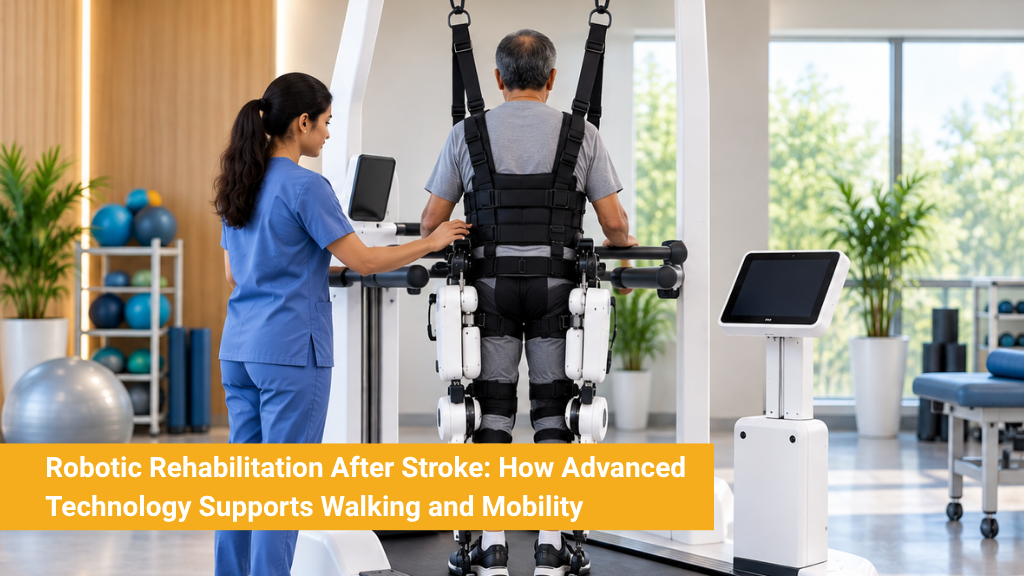
Recovering from a stroke can be a long process, especially when it affects a person’s ability to stand, walk or use one side of the body. Some patients regain movement quickly, while others continue to experience weakness, poor balance, difficulty taking steps or changes in their walking pattern.
Rehabilitation plays an important role in helping stroke survivors work toward greater mobility and independence. Along with conventional physiotherapy and neurorehabilitation, Robotic Rehabilitation is becoming an advanced option for selected patients who need structured and repetitive movement training.
At Sukino, advanced rehabilitation technology can be incorporated into a personalised stroke rehabilitation programme based on the patient’s condition, functional ability and rehabilitation goals.
What Is Robotic Rehabilitation?
Robotic rehabilitation uses specialised robotic equipment to assist patients while they practise specific movements during therapy.
After a stroke, a patient may find it difficult to repeat a movement independently because of muscle weakness, reduced coordination, balance problems or altered muscle tone. This can make conventional movement practice physically demanding.
Robotic equipment can provide controlled assistance during selected rehabilitation exercises, allowing patients to practise movements repeatedly under the supervision of trained rehabilitation professionals.
The technology is not intended to replace physiotherapists or other rehabilitation specialists. Instead, it can be used as an additional tool within a broader rehabilitation programme.
Why Is Repetitive Movement Important After a Stroke?
Walking and other everyday movements involve repeated coordination between the brain, muscles and joints.
After a stroke, the brain may have difficulty controlling movements that were previously automatic. Repeated, task-specific practice can therefore be an important part of rehabilitation.
Depending on the patient’s ability, therapy may focus on:
- Repeated stepping
- Weight shifting
- Lower-limb movement
- Balance
- Foot placement
- Walking coordination
- Transfers
- Functional activities
The amount and type of assistance required can change as the patient’s abilities develop.
How Does Robotic Gait Training Work?
Robotic gait training is a form of technology-assisted rehabilitation that focuses specifically on walking practice.
A patient who cannot yet walk independently may need significant physical support while learning to take steps. Robotic gait training equipment can provide controlled assistance during walking practice, allowing the patient to work on repetitive stepping movements in a supervised environment.
Depending on the equipment and individual rehabilitation plan, training may focus on:
- Repeated walking movements
- Step timing
- Lower-limb coordination
- Weight transfer
- Foot positioning
- Walking rhythm
- Gradually increasing active participation
The rehabilitation team determines the appropriate level of assistance according to the patient’s functional ability.
Who May Be Considered for Robotic Rehabilitation After Stroke?
Robotic rehabilitation is not automatically suitable for every stroke survivor.
A detailed assessment is important before deciding whether robotic equipment should be included in a rehabilitation programme.
The rehabilitation team may evaluate:
- Muscle strength
- Balance
- Walking ability
- Muscle tone and spasticity
- Joint movement
- Ability to follow instructions
- Level of assistance required
- Cardiovascular and overall medical condition
- Functional goals
A patient who currently requires substantial assistance with walking may have different rehabilitation needs from someone who can already walk independently but has an abnormal gait.
The treatment plan should therefore be based on the individual rather than simply the diagnosis of stroke.
How Can Robotic Rehabilitation Support Stroke Recovery?
For suitable patients, robotic rehabilitation can provide an opportunity for structured and repetitive movement practice.
It may be incorporated into therapy for patients experiencing:
- Difficulty Walking : Patients who cannot walk independently may need supported practice to work on stepping and lower-limb movement.
- Lower-Limb Weakness : Weakness on one side of the body is common after stroke. Rehabilitation can focus on improving the patient’s ability to use the affected limb during functional activities.
- Poor Balance : Balance problems can make standing and walking unsafe. Rehabilitation can include controlled weight-shifting and mobility exercises based on the patient’s abilities.
- Abnormal Walking Patterns : Some stroke survivors walk with shorter steps, uneven weight distribution or difficulty positioning the affected foot. Gait-focused rehabilitation can address these functional limitations.
- Reduced Mobility : For patients with significant mobility limitations, technology-assisted rehabilitation may provide another way to practise movement while receiving appropriate support.
Have Questions About Your Loved One's Recovery?
Ask a Rehabilitation Expert →Robotic Rehabilitation Does Not Replace Conventional Therapy
One important point about robotic therapy after stroke is that it is not a standalone replacement for conventional rehabilitation.
Stroke recovery can involve much more than walking.
A comprehensive rehabilitation programme may include:
- Physiotherapy
- Robotic rehabilitation
- Robotic gait training
- Balance training
- Occupational therapy
- Speech and language therapy
- Swallowing rehabilitation
- Functional and activities-of-daily-living training
- Nursing care when required
- Medical supervision
The combination of therapies depends on the patient’s individual needs.
For example, a patient may use robotic gait training to practise walking while also working with a physiotherapist on strength and balance and an occupational therapist on everyday activities.
How Sukino Can Help With Robotic Stroke Rehabilitation
At Sukino Healthcare, stroke rehabilitation follows a multidisciplinary approach designed around the patient’s functional limitations and recovery goals.
For patients who require advanced rehabilitation, robotic rehabilitation and robotic gait training may be incorporated when considered appropriate following assessment.
Sukino’s rehabilitation approach can address several areas of stroke recovery, including:
- Mobility and walking: Physiotherapy and gait training can focus on walking ability, balance, transfers and lower-limb function.
- Advanced robotic rehabilitation: Suitable patients may use robotic equipment to support structured and repetitive movement practice.
- Occupational therapy: Patients can work on everyday activities such as dressing, grooming, transfers and other tasks needed for greater independence.
- Speech and swallowing rehabilitation: Stroke can affect communication and swallowing. These areas can be addressed as part of the patient’s overall rehabilitation programme when required.
- Nursing and medical support: Patients with more complex rehabilitation needs may require ongoing nursing and medical support alongside therapy.
This multidisciplinary approach allows rehabilitation to address the patient as a whole rather than focusing only on walking.
Robotic Rehabilitation for Stroke Patients in Hyderabad and Kozhikode
Families searching for stroke rehabilitation in Hyderabad or stroke rehabilitation in Kozhikode may be looking for more than routine physiotherapy, particularly when the patient has significant mobility limitations.
Sukino’s rehabilitation facilities in Hyderabad and Kozhikode, along with its centres in other locations, provide patients and families with access to rehabilitation services based on individual needs.
For patients who may be suitable for advanced technology-assisted rehabilitation, the rehabilitation team can assess whether robotic rehabilitation or robotic gait training should form part of their treatment programme.
The appropriate approach will depend on the patient’s medical condition, functional ability and rehabilitation goals.
When Should a Stroke Patient Consider Advanced Rehabilitation?
A patient may benefit from a detailed rehabilitation assessment if they continue to experience:
- Difficulty standing
- Difficulty walking
- One-sided weakness
- Poor balance
- Difficulty moving the affected leg
- Abnormal walking patterns
- Dependence on another person for mobility
- Difficulty performing everyday activities
An assessment can help identify the patient’s current limitations and determine which combination of therapies may be appropriate.
Frequently Asked Questions
Robotic rehabilitation uses specialised equipment to assist patients during repetitive and controlled movement exercises. It can be incorporated into a broader stroke rehabilitation programme for selected patients.
Robotic rehabilitation can provide structured walking and movement practice for suitable patients. However, recovery differs between individuals, and no rehabilitation technology can guarantee a specific outcome.
Robotic gait training uses technology-assisted equipment to support repeated walking movements. It can help suitable patients practise stepping, weight transfer and walking patterns under professional supervision.
Robotic therapy and physiotherapy serve different roles and can be used together. Robotic equipment can provide technology-assisted movement practice, while physiotherapy addresses strength, balance, mobility and functional movement more broadly.
No. Suitability depends on factors such as strength, balance, muscle tone, mobility, medical condition and the patient’s ability to participate in therapy. A professional assessment is required.
Sukino provides advanced rehabilitation approaches, including robotic rehabilitation and robotic gait training for patients who are assessed as suitable for these interventions.
Sukino has rehabilitation facilities in Hyderabad where patients can undergo an assessment and explore an appropriate multidisciplinary rehabilitation programme.
Yes. Sukino has a rehabilitation facility in Kozhikode providing rehabilitation support for patients with neurological and other complex recovery needs. The appropriate therapy programme is determined following individual assessment.
Supporting Recovery With the Right Rehabilitation Approach
Stroke recovery is different for every patient. Some people may regain mobility with conventional therapy, while others may require longer-term rehabilitation and additional support.
Robotic rehabilitation and robotic gait training can provide selected patients with technology-assisted, repetitive movement practice as part of a broader rehabilitation programme.
At Sukino, advanced rehabilitation technology can be combined with physiotherapy, occupational therapy, speech and swallowing rehabilitation, nursing and other supportive services according to the patient’s needs.
If a stroke survivor is struggling with walking, balance or mobility, a comprehensive rehabilitation assessment can help the family understand the available treatment options and determine the next step in the recovery journey.


