


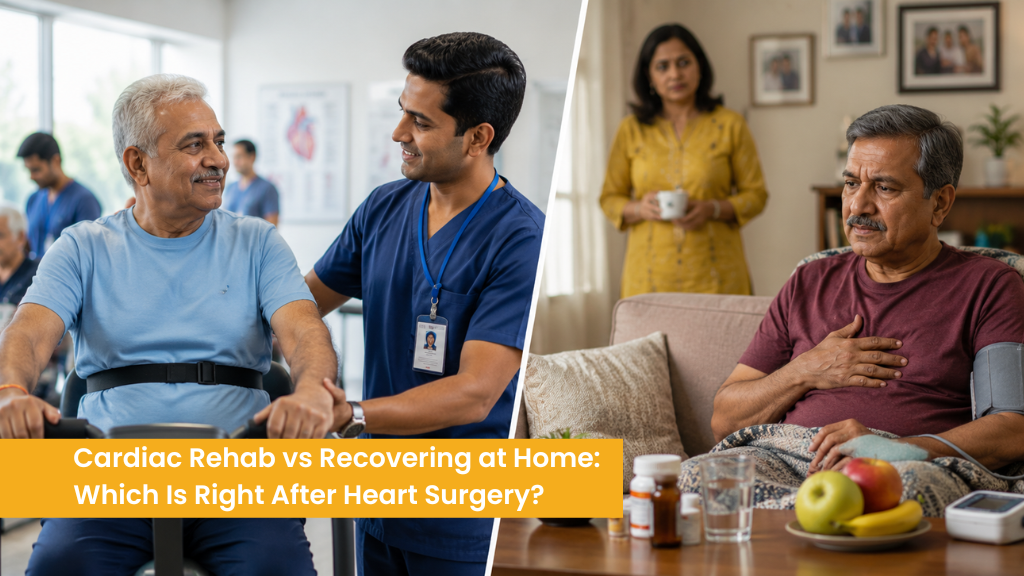
After heart surgery, most patients are eager to leave the hospital and return home. Home offers comfort, familiarity and the support of family. But once the patient is discharged, an important question remains: What is the safest and most suitable way to recover?
For some patients, recovering at home with regular follow-up and prescribed exercises may be enough. Others may need a more structured approach through a cardiac rehabilitation programme.
The right choice depends on the patient’s condition, type of surgery, strength, mobility, other health conditions and the support available at home.
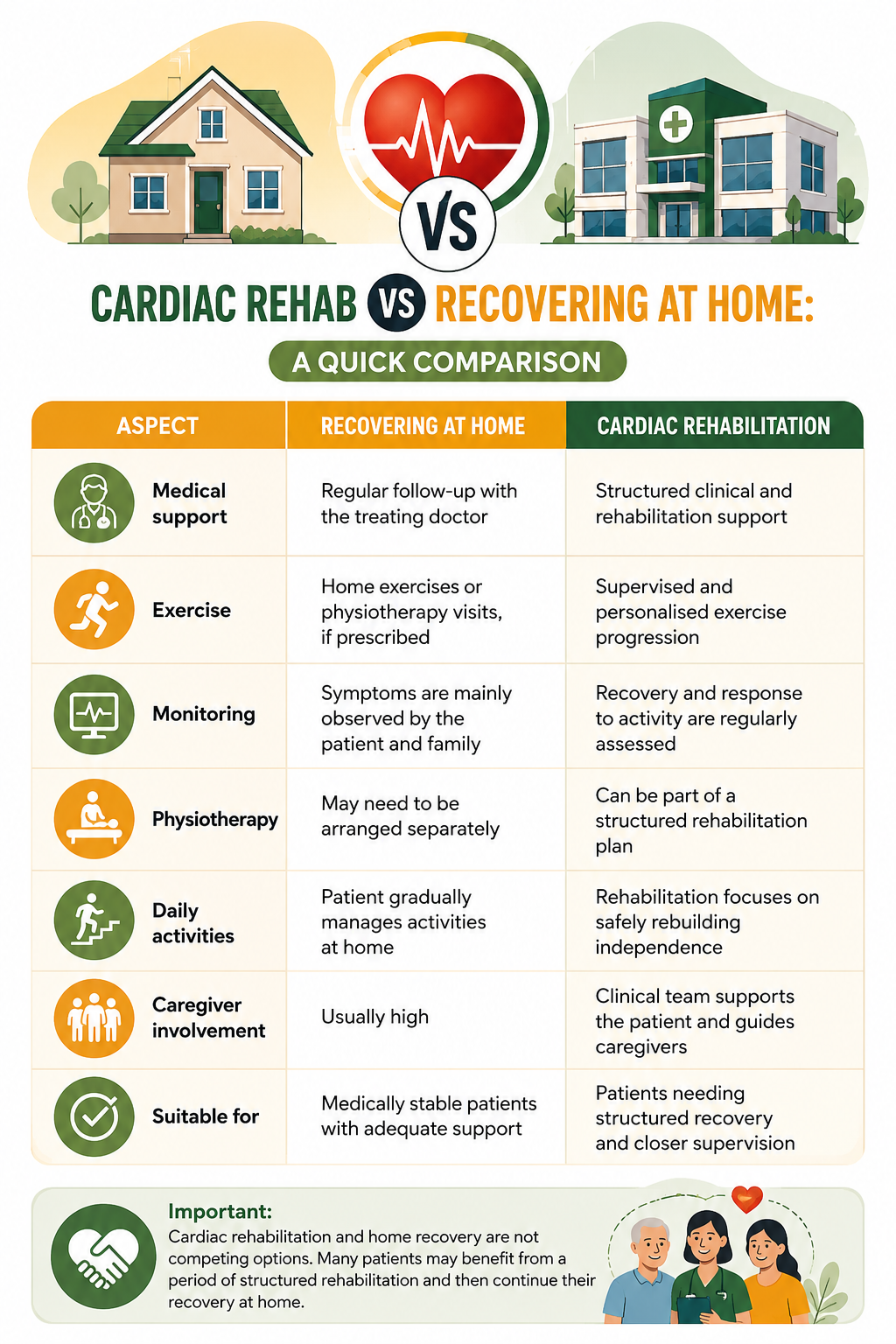
Cardiac Rehab vs Recovering at Home: A Quick Comparison
Aspect | Recovering at Home | Cardiac Rehabilitation |
Medical support | Regular follow-up with the treating doctor | Structured clinical and rehabilitation support |
Exercise | Home exercises or physiotherapy visits, if prescribed | Supervised and personalised exercise progression |
Monitoring | Symptoms are mainly observed by the patient and family | Recovery and response to activity are regularly assessed |
Physiotherapy | May need to be arranged separately | Can be part of a structured rehabilitation plan |
Daily activities | Patient gradually manages activities at home | Rehabilitation focuses on safely rebuilding independence |
Caregiver involvement | Usually high | Clinical team supports the patient and guides caregivers |
Suitable for | Medically stable patients with adequate support | Patients needing structured recovery and closer supervision |
Important: Cardiac rehabilitation and home recovery are not competing options. Many patients may benefit from a period of structured rehabilitation and then continue their recovery at home.
When Is Recovering at Home a Good Option?
Home recovery can be suitable for patients who are medically stable and able to manage most daily activities safely.
It may be a good option when:
- The treating cardiologist confirms that the patient is stable.
- The patient can walk safely and manage basic mobility.
- There are no significant post-operative complications.
- Family members or caregivers are available to help when needed.
- The patient can attend follow-up appointments.
- Prescribed exercises can be continued safely at home.
For many patients, being surrounded by family can also provide emotional comfort during recovery.
However, recovering at home still requires consistency. Medications need to be taken as prescribed, activity levels need to be increased gradually, and any concerning symptoms should be discussed with the treating medical team.
When Can Cardiac Rehabilitation Be More Suitable?
Some patients need more support before they are ready to recover independently at home.
Cardiac rehabilitation may be particularly helpful for patients who:
- Have undergone bypass surgery (CABG)
- Have had heart valve repair or replacement
- Are recovering after a heart attack
- Have experienced a prolonged ICU or hospital stay
- Feel very weak after discharge
- Need help with walking or daily activities
- Have diabetes, hypertension, kidney disease or other health conditions
- Are older and have reduced mobility
- Do not have adequate caregiving support at home
In these situations, structured rehabilitation can help patients regain strength and confidence gradually.
What Does Cardiac Rehabilitation Focus On?
Cardiac rehabilitation is not simply about exercise.
The programme focuses on different aspects of recovery, depending on the patient’s individual needs. This may include:
Improving Mobility
After a major cardiac procedure, even basic activities can feel difficult. Rehabilitation can help patients gradually improve walking, balance and overall mobility.
Building Strength and Endurance
Long hospital stays and reduced activity can lead to muscle weakness. A personalised programme can help patients gradually improve their physical strength and exercise tolerance.
Supervised Physiotherapy
Physiotherapy can help patients improve movement and functional ability. The rehabilitation team can adjust activities based on the patient’s progress and tolerance.
Monitoring Recovery
During rehabilitation, the patient’s response to physical activity can be regularly assessed. This helps guide how and when activity levels should be progressed.
Managing Long-Term Heart Health
Recovery also involves managing factors that may affect future heart health, such as physical inactivity, diet, diabetes, high blood pressure and other individual risk factors.
The Challenge of Recovering Without a Structured Plan
One common concern after heart surgery is uncertainty.
Patients may wonder:
- How much should I walk?
- Am I exercising too much?
- When can I climb stairs?
- Why do I still feel weak?
- When can I return to normal activities?
Families may also find it difficult to judge whether the patient is progressing as expected.
A structured rehabilitation programme gives patients a clearer recovery plan. Progress can be made gradually, based on the patient’s condition rather than a fixed timeline.
Can You Start With Cardiac Rehab and Continue Recovery at Home?
Yes. In fact, this can be a suitable pathway for many patients.
A patient may initially need closer support to regain strength, mobility and confidence. Once medically stable and more independent, they can continue prescribed exercises and healthy lifestyle changes at home.
The goal of rehabilitation is not to keep patients in a facility for longer than necessary. The aim is to help them become ready to return home safely and manage daily life with greater independence.
How Do You Decide Which Option Is Right?
Before deciding between recovering at home and a cardiac rehabilitation programme, consider:
- What type of heart procedure did the patient undergo?
- How strong and mobile is the patient after discharge?
- Are there other health conditions to manage?
- Does the patient need assistance with daily activities?
- Is reliable caregiving available at home?
- Has the treating cardiologist recommended rehabilitation?
There is no one answer for every patient. The recovery plan should be based on individual needs and medical advice.
Cardiac Rehabilitation in Electronic City
For patients and families looking for structured cardiac rehabilitation in Electronic City, having a dedicated recovery plan can help make the transition from hospital to home smoother.
At Sukino Electronic City, rehabilitation focuses on helping patients regain strength, improve mobility and work towards functional independence after hospitalisation. Depending on individual needs, care may include physiotherapy, nursing support, clinical supervision, nutrition guidance and multidisciplinary rehabilitation.
The rehabilitation plan should work alongside the recommendations of the patient’s treating cardiac team.


