


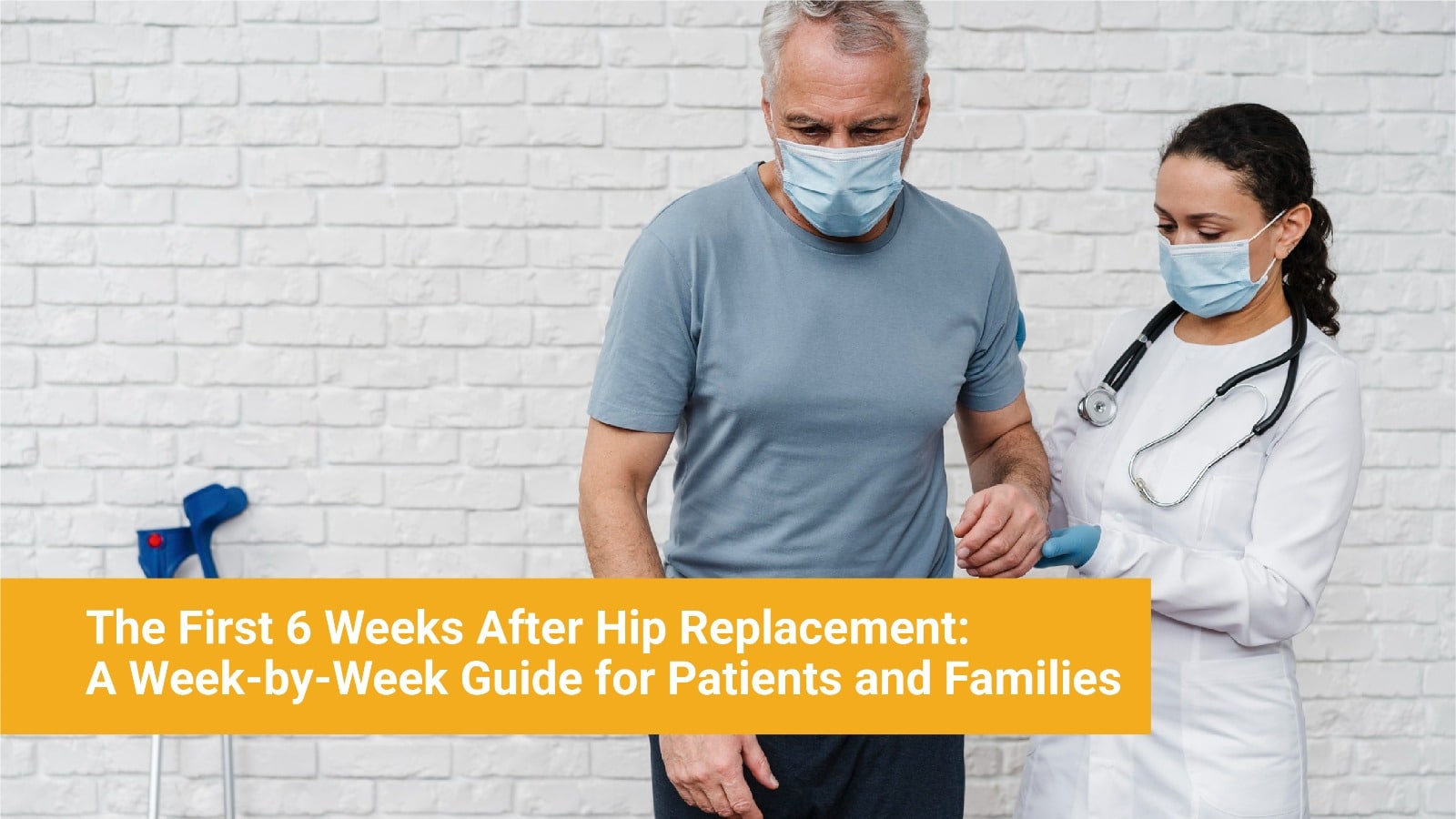
The weeks immediately following hip replacement surgery are among the most consequential in a patient’s entire recovery journey, shaping not only how quickly function returns but how completely and safely it does and yet this period is also one of the least understood by families who are trying to support a loved one at home while navigating unfamiliar clinical guidance, equipment, and precautions. This week-by-week guide is intended to help patients and families understand what to expect at each stage of the first six weeks, so that progress can be measured with confidence and warning signs recognised early.
Recovery at a Glance
In the table below you can get an overview of the four key phases within the six-week recovery window, each with its own clinical priorities and goals.
Phase | Setting | Key Focus |
Week 1 | Hospital / early home | Walking with a walker, pain management, hip precautions |
Week 2 | Home or rehab facility | Daily routine, physiotherapy exercises, wound care |
Weeks 3–4 | Home or rehab facility | Stair climbing, increasing strength, OT assessment |
Weeks 5–6 | Home | Balance training, reducing walking aid, six-week review |
Week One: The First Days After Surgery
The first week after hip replacement is defined by the tension between two competing clinical priorities: the need for rest & surgical wound protection on one hand and the need for early movement on the other (equally important). Most patients will begin walking with a walker within twenty-four hours of surgery under the supervision of a physiotherapist, because early mobilisation is essential for preventing blood clots, maintaining lung function and beginning the process of restoring muscle activation around the new joint. Pain and swelling are expected during this period and should be managed with prescribed medication taken on schedule (most people wait until discomfort becomes severe). Patients should sleep with a pillow between the legs to maintain correct hip alignment, avoid bending the hip beyond ninety degrees, and ensure that nothing is placed on the floor that requires bending to retrieve. Hip replacement rehabilitation whether delivered in an inpatient setting or at home, begins precisely at this stage.
Week Two: Building Confidence at Home
By the second week, most patients will have transitioned home or to a dedicated rehabilitation facility & the focus shifts on creating a safe daily routine and a physiotherapy plan that best suits the patient. Walking distances increase gradually, always with the walking aid and exercises prescribed by the physiotherapist (including ankle pumps, heel slides, and gentle hip abductions) should be performed consistently several times a day. Fatigue is normal and expected; the body is directing significant resources toward healing, and adequate rest between exercise sessions is as important as the sessions themselves. Wound inspection should continue daily, with any sign of increased redness, warmth, or discharge reported to the clinical team promptly.
Planning Hip Replacement Recovery for a Loved One?
With Sukino you can have access to a structured hip replacement rehabilitation programme (both inpatient and home-based) with multidisciplinary clinical teams including but not limited to physiotherapists, occupational therapists and nursing staff, giving you the best care at every stage of the six week recovery period. As soon as you get yourself (or your loved ones) enrolled in a structured rehabilitation programme you are at a higher chance of improved outcomes and reduced risk of complications.
Speak with our rehabilitation specialists today.Weeks Three and Four: Increasing Strength and Stability
The third and fourth weeks mark a meaningful shift for most patients, as pain begins to ease, confidence in movement grows and physiotherapy sessions become more demanding. Stair climbing may be introduced during this phase, beginning with the step-to-step technique and always leading with the unaffected leg on the way up. Hip precautions (avoiding internal rotation, extreme flexion, and crossing the legs) remain essential and must be observed consistently in every activity of daily life, from dressing to sitting to getting in and out of a vehicle. This is also the period during which occupational therapists assess the home environment for safety risks and recommend adaptive equipment if needed. Patients receiving hip rehabilitation in Bangalore through inpatient or home-based programmes benefit significantly from this multidisciplinary input during weeks three and four.
Weeks Five and Six: Preparing for Greater Independence
By weeks five and six, many patients are walking with greater ease and some are beginning to reduce their reliance on a walking aid, though this transition should always be guided by the physiotherapist rather than determined by the patient independently. The exercise programme becomes progressively more demanding, with the introduction of balance training, gentle strengthening in standing, and activities that more closely approximate the demands of daily life. Hip precautions are typically reviewed at the six-week surgical follow-up, at which point the orthopaedic surgeon will assess the joint and advise on whether certain restrictions can be lifted. Returning to driving, resuming work, and participating in recreational activities all depend on the outcome of this review and should not be attempted before it. Structured hip replacement rehabilitation at Sukino (whether delivered in a facility or through managed home healthcare) ensures that patients arrive at this milestone with the strength, confidence and clinical oversight they need to progress safely.
Conclusion
The six weeks following hip replacement surgery represent a period of significant clinical transition, during which consistent adherence to precautions, structured physiotherapy, and attentive family support all play a direct role in determining the quality and completeness of recovery. Families who understand what each week demands – and who know when to seek clinical input – are far better placed to support their loved one through this journey safely. If you are planning post-operative care following hip replacement and would like to speak with the orthopaedic rehabilitation team at Sukino Rehabilitation in Bangalore, we are here to help.
FAQs
Hip precautions – which include avoiding bending the hip beyond ninety degrees, crossing the legs, and rotating the foot inward – must be observed consistently across all daily activities for the full six weeks, and in some cases beyond, until the surgeon confirms at the follow-up appointment that restrictions can be safely lifted.
Most patients begin walking with a walker within twenty four hours of surgery under physiotherapy supervision as early mobilisation is a clinical priority for preventing complications such as deep vein thrombosis and supporting joint recovery.
Some degree of pain and swelling is expected throughout the early recovery period and should be managed with prescribed medications taken on schedule; pain that is worsening rather than gradually improving, or is accompanied by fever or changes at the wound site, should be reported to the clinical team immediately.
Physiotherapy is the central driver of recovery during this period, guiding the restoration of strength, balance and functional movement around the new joint, and should be conducted under professional supervision rather than independently to ensure that exercises are performed safely and progressed appropriately.
Both driving and returning to work depend on the outcome of the six-week surgical review, the nature of the patient’s occupation, and whether the operated leg is the one used for vehicle controls and should not be attempted before the surgeon explicitly confirms that it is safe to do so.
Families should contact the clinical team without delay if the patient develops increasing pain, swelling or warmth at the hip, a fever above 38 degrees Celsius, redness or discharge from the wound, sudden shortness of breath or calf pain or swelling as these may indicate infection, deep vein thrombosis or other complications requiring urgent attention.
Sukino Rehabilitation offers dedicated hip replacement rehabilitation across its inpatient and home-based programmes, with multidisciplinary teams including physiotherapists, occupational therapists, and nursing staff, supporting patients from the first post-operative day through to full functional recovery.


