


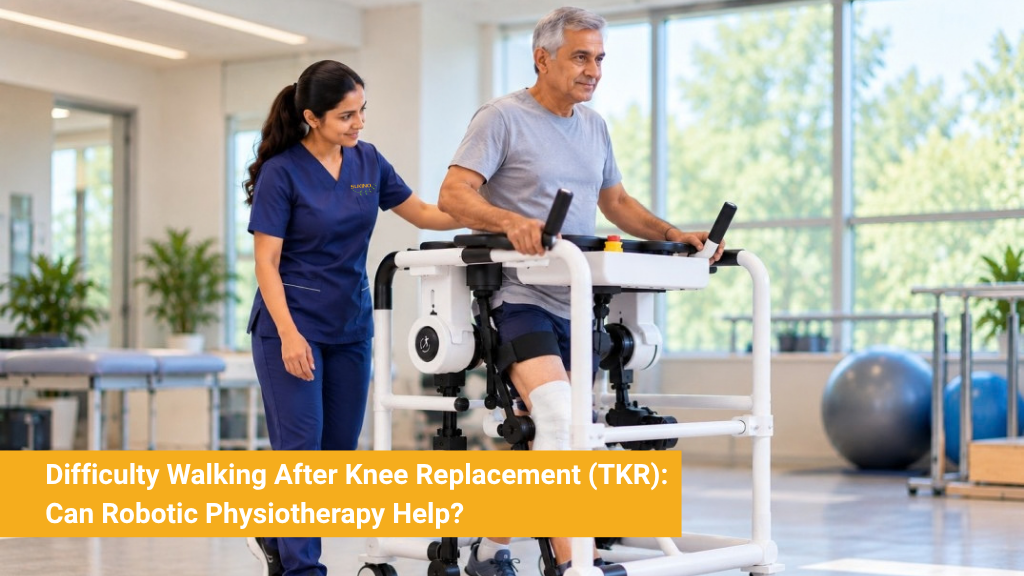
Knee replacement surgery, also known as (TKR), is performed to reduce pain and improve mobility when a damaged knee affects everyday activities. However, having a TKR does not mean that normal walking returns immediately. Difficulty walking after TKR can occur during recovery because the muscles around the knee may be weak, the joint may feel stiff, balance may be reduced, and the body needs time to adapt to the new joint.
Rehabilitation plays an important role during this stage. Physiotherapy after TKR, strengthening exercises, mobility training and gait training can help patients gradually regain movement, stability and confidence.
For some patients, gait training with advanced Robotic Physiotherapy rehabilitation may also be considered as part of a personalised rehabilitation programme. At Sukino, advanced rehabilitation technology is used to support areas such as gait and walking, balance, strength, joint mobility and functional movement.
Why Mobility Becomes Difficult After TKR Surgery?
Several factors can affect walking after total knee replacement.
- Muscle Weakness
The muscles around the knee may become weak after surgery and a period of reduced activity. This can make standing, walking, climbing stairs and performing everyday movements more difficult.
Strengthening exercises and progressive functional training are important parts of TKR rehabilitation because they help the patient gradually rebuild lower-limb strength.
- Knee Stiffness
Reduced range of motion can affect how easily a person bends and straightens the knee while walking.
After TKR, rehabilitation may focus on gradually improving knee mobility while helping the patient regain functional movement.
- Reduced Balance and Confidence
Some patients may initially feel uncertain when putting weight on the operated leg. This can affect their walking pattern and may lead them to depend more heavily on a walker or other support.
Balance training and supervised gait practice can help patients gradually become more comfortable with movement.
- Changes in Walking Pattern
Weakness, stiffness, pain or fear of putting weight through the operated leg can temporarily change the way a person walks.
Gait training after TKR can help address these movement patterns as recovery progresses. Depending on the patient’s needs, gait training may involve conventional physiotherapy, supported walking exercises or advanced rehabilitation technology.
- Reduced Endurance
Even when the knee itself is improving, overall strength and endurance may be reduced after surgery or a period of limited physical activity.
This means TKR rehabilitation is not only about the knee. It can also involve improving strength, balance, endurance, mobility and functional independence.
Sukino’s knee replacement rehabilitation programme includes assessment of range of motion, strength, stability and functional ability before developing an individualised rehabilitation plan.
Can Robotic Physiotherapy Help After TKR Surgery?
Advanced Robotic Physiotherapy can help selected patients who continue to have trouble with walking, strength, balance or functional movement after TKR.
Robotic Physiotherapy does not replace the physiotherapist. Instead, specialised rehabilitation equipment can provide controlled, repetitive and supported movement while the therapist monitors the patient’s performance and adjusts the rehabilitation programme according to their needs.
At Sukino, advanced rehabilitation systems are designed to support areas such as:
- Gait and walking
- Balance and coordination
- Strength and endurance
- Joint mobility
- Lower-limb function
- Early mobilisation
- Functional movement
The type of rehabilitation technology used depends on the patient’s condition, recovery stage, functional ability and rehabilitation goals.
How Can Robotic Gait Training Support Walking After TKR?
One application of advanced rehabilitation technology is robotic gait training.
Robotic gait training uses specialised equipment to provide structured walking practice with varying levels of support. For patients who are not yet able to walk confidently or maintain a consistent walking pattern, supported gait training can provide an environment where walking movements can be practised under professional supervision.
Depending on the rehabilitation system and the patient’s requirements, gait training may support:
- Walking practice
- Balance and posture
- Progressive weight bearing
- Lower-limb movement
- Walking confidence
- Endurance
- Functional mobility
Sukino’s advanced rehabilitation technology includes robotic and body-weight-supported systems designed to assist with walking and mobility.
The purpose is not simply to make a patient walk with equipment. The focus is on using appropriate rehabilitation methods to help the patient work towards better movement, functional ability and independence.
Who May Benefit From Robotic Physiotherapy After TKR?
Robotic Physiotherapy is not required for every person who undergoes TKR.
Some patients recover well with conventional physiotherapy and a structured home exercise programme. Others may experience persistent difficulty with walking, reduced strength, poor balance, limited mobility or difficulty progressing through functional activities.
A rehabilitation assessment can help determine whether advanced technology may be appropriate.
The rehabilitation team may consider:
- Current walking ability
- Knee range of motion
- Lower-limb strength
- Balance
- Weight-bearing ability
- Gait pattern
- Endurance
- Functional independence
- Recovery stage
- Other medical or neurological conditions
The decision to use advanced Robotic Physiotherapy should therefore be based on the patient’s individual rehabilitation needs rather than simply the fact that they have undergone TKR.
When Should You Seek Help for Difficulty Walking After TKR?
Some difficulty walking is expected during recovery, but persistent or worsening difficulty walking after TKR should be discussed with the treating orthopaedic or rehabilitation team.
Medical assessment is particularly important if walking difficulty is accompanied by symptoms such as increasing redness or warmth around the surgical area, fever, wound discharge, sudden instability or rapidly worsening pain.
If recovery has slowed or walking remains difficult, a rehabilitation assessment can help identify whether the main limitation is related to:
- Muscle strength
- Knee mobility
- Balance
- Gait mechanics
- Endurance
- Weight-bearing ability
- Functional movement
Identifying the main limitation can help the rehabilitation team select appropriate exercises and, when suitable, technology-supported rehabilitation.
Have Questions About Your Loved One's Recovery?
Ask a Rehabilitation Expert →How Sukino Can Help With TKR Rehabilitation
Sukino provides structured rehabilitation programmes for patients recovering after partial or total knee replacement.
The TKR rehabilitation approach includes assessment of mobility, strength, stability and functional ability, followed by an individualised rehabilitation plan. Depending on the patient’s needs, the programme may include physiotherapy, strengthening exercises, range-of-motion exercises, gait training and functional training.
Sukino’s advanced rehabilitation technology supports areas including:
- Gait and walking
- Balance and coordination
- Strength and endurance
- Joint mobility
- Lower-limb function
- Early mobilisation
- Functional independence
The appropriate rehabilitation approach is selected according to the patient’s clinical needs, recovery stage and functional goals.
For patients looking for knee replacement rehabilitation in Bangalore, Sukino provides structured rehabilitation support. The organisation also offers rehabilitation services across multiple locations, with technology availability varying between centres.
Frequently Asked Questions
Difficulty walking can occur during the recovery period because of muscle weakness, stiffness, reduced balance, pain and reduced activity. Rehabilitation can help address these limitations progressively.
Advanced robotic physiotherapy may help selected patients who have difficulty with walking, balance, strength or functional movement. It can be incorporated into a broader rehabilitation programme based on the patient’s individual needs.
Robotic gait training uses specialised rehabilitation equipment to provide structured and supported walking practice. Depending on the equipment, it may provide assistance with body weight, movement, balance or progressive walking practice.
No. Not every patient needs robotic physiotherapy. A clinical assessment can help determine whether it is appropriate based on the patient’s recovery stage, functional ability and rehabilitation goals.
Recovery varies between individuals. Factors such as overall health, muscle strength, mobility before surgery, surgical factors and participation in rehabilitation can influence walking recovery.
Some exercises can be performed at home when prescribed by a rehabilitation professional. However, patients with significant walking difficulty, weakness, balance problems or other rehabilitation needs may benefit from supervised rehabilitation.
Conclusion
Difficulty walking after TKR does not necessarily mean that recovery has failed. Muscle weakness, knee stiffness, balance problems, reduced endurance and changes in walking patterns can all affect mobility during recovery.
Physiotherapy remains an important part of TKR rehabilitation, while gait training with advanced robotic physiotherapy rehabilitation may provide additional support for selected patients who require more structured or supported movement practice.
At Sukino, the rehabilitation approach combines clinical assessment, physiotherapy, functional training and advanced rehabilitation technology where appropriate. The focus is on selecting the right rehabilitation approach for the patient’s needs and helping them work towards improved mobility, confidence and functional independence.
Related service: Advanced Robotic Rehabilitation at Sukino


