


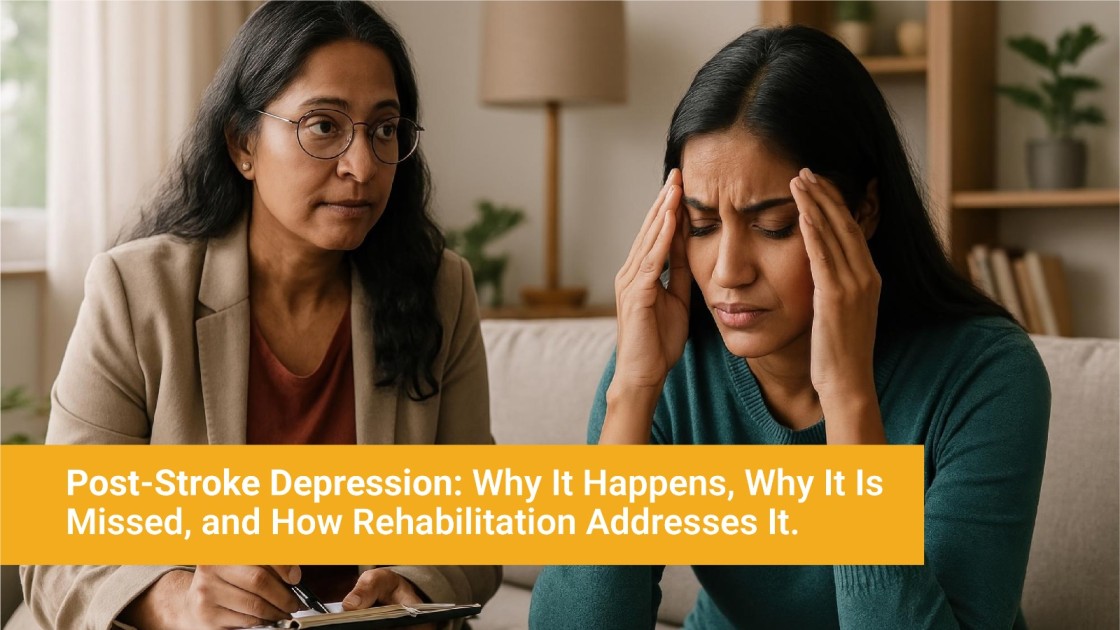
She had survived the stroke. The family members were happy and kept telling themselves that what mattered was. The scan showed the damage. The speech was slower. The right hand needed work. But she was alive, she was home, and the physiotherapy sessions were going reasonably well.
What they did not know how to explain (what nobody had told them to watch for) was why she had stopped wanting to get out of bed. Also why did she wave the therapist away? Why did she sit by the window for hours without speaking and say (whenever they asked) that she was fine?
She was not fine. She had post-stroke depression. And she had it for four months before anyone identified it.
This is not a rare story. Post-stroke depression (PSD) affects between 30-50% of stroke survivors. It is one of the most significant barriers to recovery. And it remains one of the most consistently overlooked complications in stroke care.
Why Post-stroke Depression Happens
Depression after stroke is not simply a psychological response to a frightening event (the grief is real and valid). PSD has biological roots. The stroke itself damages brain regions that regulate mood, motivation, and emotional processing. Disrupted neurochemistry (including disruption in serotonin and dopamine pathways) creates a physiological predisposition to depression that exists independently of what the person thinks or feels about their situation.
On top of this sits the lived experience of stroke: the loss of independence, changed identity, uncertain prognosis and the relentlessness of rehabilitation. For many survivors the emotional weight of what has happened only fully lands weeks or months after the acute event when the adrenaline of survival fades & the change becomes more apparent.
Why Post-stroke Depression Is So Often Missed
Why post-stroke depression is so often missed:
|
What Post-stroke Depression Looks Like in Practice
Because PSD does not always look like textbook depression, family members and clinicians need to know the full range of presentations. They are:
- Refusing or disengaging from therapy sessions without clear physical reason
- Persistent fatigue disproportionate to physical exertion
- Increased irritability, frustration or emotional outbursts
- Withdrawal from family conversations and social interaction
- There is loss of interest in hobbies, prayer, television
- Expressing hopelessness about recovery or a sense of being a burden
- Disordered sleep (either inability to sleep or sleeping excessively).
Any of these, sustained over more than two weeks, warrants a direct conversation with the rehabilitation team.
Why Post-stroke Depression Slows Physical Recovery
This is where the stakes become concrete. Patients with untreated PSD attend fewer therapy sessions. They exert less effort during the sessions they do attend. They are less likely to practise exercises independently, less motivated to learn adaptations suggested to them and more likely to withdraw from family support.
The outcome data is consistent: stroke survivors with depression have worse functional outcomes at six months, higher rates of hospital readmission and significantly lower quality of life scores. PSD is not a separate problem from physical recovery. It is a direct obstacle to it.
Stroke Recovery That Treats the Whole Person
At Sukino, our neuro rehabilitation programmes in Bangalore, Kochi and Coimbatore are built on one understanding: recovery is not only physical. Our team of neurologists, physiotherapists, occupational therapists, speech therapists, and psychologists work together to address post-stroke depression as part of - not separate from - the rehabilitation journey.
Call usHow Rehabilitation Addresses Post-stroke Depression
The most effective approach to PSD is not to treat it separately from the rehabilitation programme – it is to weave mental health support into every element of recovery. At Sukino, this is what that looks like in practice:
Rehabilitation Discipline | Role in Addressing Post-stroke Depression |
Neuropsychology | Formal screening for PSD; cognitive-behavioural support; emotional regulation strategies tailored to stroke survivors |
Physiotherapy | Structured exercise, which is clinically shown to reduce depressive symptoms by releasing endorphins and restoring a sense of physical agency |
Occupational Therapy | Reintroducing meaningful daily activities – cooking, reading and prayer – that rebuild identity and purpose |
Speech Language Therapy | Reducing isolation caused by aphasia; giving patients tools to communicate distress and connect with family |
Nursing & Care Team | Daily observation of mood, motivation, and withdrawal – the frontline of early detection |
Family Counselling | Equipping caregivers to recognise PSD, respond without minimising, and support without overwhelming |
FAQs
Post-stroke depression is a clinical condition in which stroke survivors experience persistent low mood, loss of motivation, and emotional withdrawal following their stroke. Research suggests it affects between 30 to 50% of stroke survivors, making it one of the most common – and most under-treated – complications of stroke.
PSD can develop at any point – sometimes within the first few weeks, and in other cases months after the event. It is important to screen regularly throughout the rehabilitation and recovery period, not just at the point of discharge.
Feeling upset after a stroke is natural and expected. For different people the severity of post-stroke depression is different in its persistence, intensity and impact on function. When low mood lasts more than two weeks with reduced motivation to for physiotherapy, disrupted sleep and appetite or hopelessness, it is the time for clinical assessment and treatment.
Yes – this is well established in research. Patients with untreated PSD are less likely to engage consistently with physiotherapy, occupational therapy and speech therapy. They tend to have worse functional outcomes at six and twelve months, higher rates of hospital readmission and a significantly lower quality of life.
Treatment usually involves a combination of structured psychological support, antidepressant medication where appropriate, meaningful activity and exercise and family involvement. In a rehabilitation setting, these elements are integrated into the daily care plan rather than treated as a separate referral.
Sukino’s multidisciplinary teams in Bangalore and Kochi include psychologists and trained doctors who screen for PSD as a standard part of neurological rehabilitation. Emotional health is treated as core to recovery with regular review, family counselling and integrated psychological support throughout the programme.


