


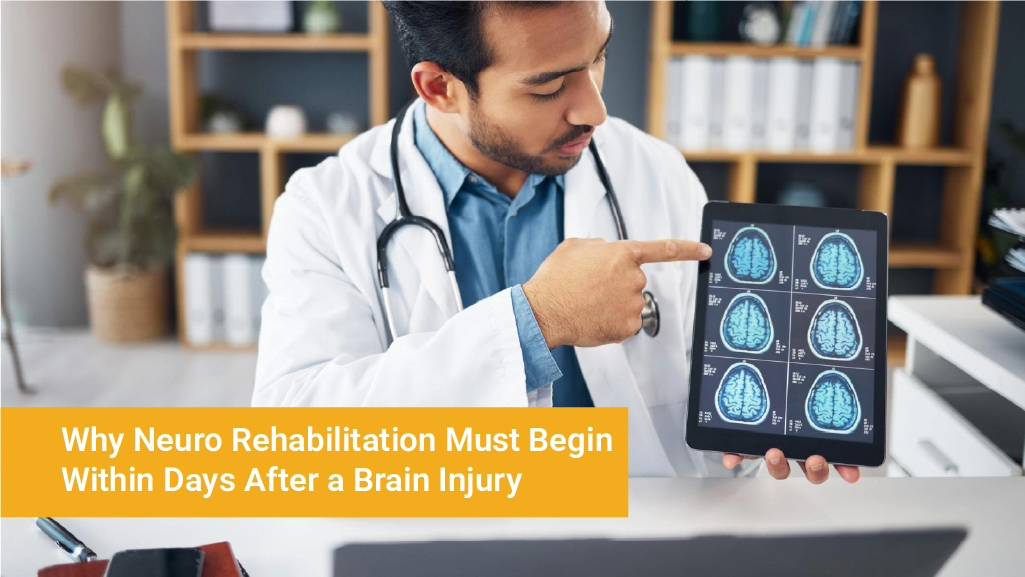
Picture a family in the waiting area of a hospital in Bangalore. Their father had a stroke at 6 in the morning and was found slumped in his chair and one side of his face drooping. He has been stabilised. The scan shows damage to the left hemisphere. A doctor steps out and tells them: The next few days will define the next few years.
That is not an exaggeration. What happens in the hours and days immediately following a brain injury whether it is a stroke, traumatic brain injury (TBI), or brain damage due to insufficient oxygen shapes how much function a person can ultimately reclaim. The window is real. And it closes faster than most families realise. At Sukino Functional Neurological Disorder Treatment Centre we understand this.
What Happens to the Brain After Injury
When the brain sustains injury, it enters a state of emergency. Cells in the directly damaged area begin to die. But around that core, a much larger section of nerve cells that are still alive, still capable, enters a kind of standby mode. They are under stress, not getting enough oxygen, and receiving disrupted signals. Whether these cells eventually recover or are lost permanently depends, in large part, on what happens next.
This is the foundation of early neurological therapy services. It is not about pushing a weakened body too hard, too soon. It is about sending the right signals to the brain – deciding which connections to keep and which to abandon.
Neuroplasticity: The Brain's Rebuilding Mechanism
The human brain has a remarkable capacity to reorganise itself. When one area is damaged, other regions can, with the right stimulation, take over some of its functions. This process (called neuroplasticity) is most active in the days and weeks immediately following injury. It does not switch off entirely, but it is never again as responsive as it is in that early window.
Rehabilitation exercises are, at their core, neuroplasticity triggers. Repeated, purposeful movement and cognitive activity create and reinforce new neural pathways. The earlier this begins, the more pathways the brain has the opportunity to establish – before scar tissue sets in, before muscle groups atrophy, before the brain starts adapting in a less flexible way around the injury.
The Rehabilitation Timeline: What Happens When
Early rehabilitation does not mean sending a patient to the gym the morning after a stroke. It is carefully customised, medically supervised and adapted to what the person can tolerate at each moment.
Timeframe | Rehabilitation Focus |
0-24 hours | Medical stabilisation; swallowing assessment; positioning to prevent pressure injuries and joint stiffness |
24-48 hours | Physiotherapy begins; passive limb movements; respiratory support if needed; cognitive orientation |
48-72 hours | Active rehabilitation commences; occupational therapy; early speech-language assessment |
Day 4 onwards | Goal-directed therapy intensifies; family training begins; discharge and long-term plan drafted. |
Every Hour Counts. Act Now.
The Cost of Waiting
When rehabilitation is delayed sometimes because families are waiting for the patient to ‘get stronger first’, sometimes because the right facility is not immediately accessible, the consequences can be significant and lasting.
Muscles that are not moved begin to shorten and tighten, a process called contracture, which can permanently limit the range of motion, joints stiffen and blood clots become more likely. Swallowing difficulties, if unaddressed, lead to aspiration pneumonia. And perhaps most importantly, the brain’s peak neuroplastic window begins to close.
Patients who begin rehabilitation early are consistently shown to have better functional outcomes at six months and beyond including better mobility, better communication, and greater independence in daily tasks. The difference is not marginal. It is often the difference between needing full-time care and returning to a life one recognises.
If you want to know more about outpatient neuro rehab near me you can contact our neuro rehabilitation in Bangalore, Kochi and Coimbatore.
What Early Neuro Rehabilitation Actually Looks Like
In a well-structured programme, early rehabilitation is a coordinated effort across disciplines. At Sukino, this includes:
- A physiotherapist working on posture, positioning and early mobilisation to restore movement patterns
- An occupational therapist helping the patient relearn basic daily tasks like holding a cup and transferring from bed to chair
- A speech-language therapist assessing swallowing safety and beginning communication work
- A neuropsychologist monitoring cognitive function, attention, and emotional regulation
- Nursing and care staff trained to reinforce therapeutic goals around the clock not just during formal sessions.
Equally important is what happens with the family. Caregivers who understand the recovery process, who know how to position a limb correctly or how to prompt a memory exercise at home, extend the reach of rehabilitation far beyond the therapy room.
FAQs
Ideally within 24 to 72 hours of the injury once the patient is medically stable. Early intervention significantly improves long-term recovery outcomes.
Neuroplasticity is the brain’s ability to rewire itself by forming new neural connections. Rehabilitation exercises stimulate this process and help the brain compensate for damaged areas and this capacity is strongest in the early weeks after injury.
A comprehensive programme typically includes physiotherapy, occupational therapy, speech-language therapy, neuropsychological support and swallowing rehabilitation. At Sukino we coordinate all these in under a single care plan.
Yes and more often than people expect. While every brain injury is different and outcomes depend on its nature and severity, meaningful functional recovery is achievable even for patients with serious injuries. The brain has a remarkable capacity to adapt, and with early, consistent, specialist rehabilitation, that capacity can be put to work. The sooner intervention begins and the more sustained the effort, the better the chances of regaining real independence and quality of life.
Early rehabilitation helps prevent muscle contractures, deep vein thrombosis, pressure ulcers, pneumonia and cognitive deterioration – all of which are significantly more likely in patients who remain immobile after injury.
Recovery timelines vary widely. Some patients make rapid gains in the first three to six months; others continue improving for years. The goal of rehabilitation is to maximise function at every stage of recovery.
Sukino offers integrated neurological rehabilitation combining physiotherapy, occupational therapy, psychological support, and speech therapy for neuro patients with dedicated family counselling and caregiver training.


